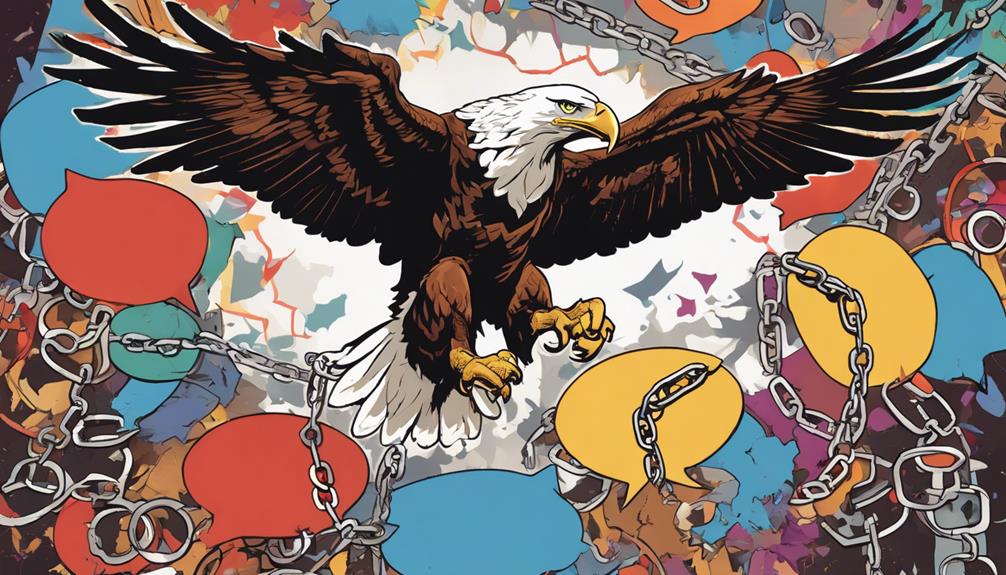
As I navigate the intricacies of online discussions, I'm reminded that free expression is the foundation of a healthy democracy – yet it's facing unprecedented hurdles. Social media has empowered marginalized voices, but perpetuated censorship, misinformation, and echo chambers. Cancel culture has silenced opposing viewpoints, stifling vital conversations. Minorities' voices are often suppressed, and artistic expression is at risk. It's time to reclaim our right to free expression, nurturing open dialogue spaces that embrace diverse perspectives. By grasping these intricacies, I've come to realize that promoting free expression is an ongoing struggle – one that requires constant vigilance and exploration.
The Evolution of Free Speech
As I explore the intricacies of free speech, I'm struck by the profound evolution it has undergone since the dawn of human civilization. The concept of free speech has undergone a remarkable transformation, shaped by the struggles and triumphs of individuals and societies seeking to express themselves. From ancient Greek philosophers to modern-day activists, the fight for free speech has been a relentless pursuit of human freedom.
Historical origins of free speech can be traced back to ancient Greece, where philosophers like Socrates and Aristotle advocated for the right to express one's thoughts. The concept gained momentum during the Enlightenment, with thinkers like John Locke and Voltaire championing the cause of free speech. Yet, it's not just the historical origins that are significant; current challenges to free speech are equally pressing. In today's world, legal protections for free speech are being tested like never before. Governments, corporations, and special interest groups are constantly seeking to curtail our right to express ourselves.
Despite these challenges, cultural shifts are driving a renewed emphasis on free speech. The rise of social and political movements has created a sense of urgency around protecting our right to free expression. As I navigate this intricate terrain, I'm reminded that free speech is not just a fundamental human right, but a cornerstone of democratic societies. It's our responsibility to champion this right, ensuring that future generations can continue to express themselves without fear of persecution or censorship.
Social Media's Double-Edged Sword
Through the perspective of free speech, I've realized that social media platforms have emerged as a double-edged blade, simultaneously amplifying our voices and stifling our independence. On one hand, social media has enabled digital activism, allowing marginalized communities to raise their voices and bring attention to urgent issues. It has provided a space for individuals to share their stories, mobilize support, and challenge oppressive systems. Nevertheless, this same platform has also given rise to online censorship, where voices are silenced, and dissenting opinions are suppressed.
Here are some key aspects of social media's double-edged sword:
- Amplifying voices: Social media has given a platform to marginalized communities, enabling them to share their experiences and raise awareness about social injustices.
- Digital activism: Social media has empowered online campaigns, petitions, and movements that have led to real-world change.
- Online censorship: Social media companies have been accused of censoring certain voices, suppressing dissenting opinions, and perpetuating echo chambers.
- Ethical concerns: Social media platforms have raised ethical concerns regarding data privacy, algorithmic bias, and the spread of misinformation.
As we navigate the intricacies of social media, it's crucial to recognize both its potential to amplify our voices and its capacity to stifle our independence. By acknowledging these contradictions, we can strive towards creating a digital environment that truly champions free speech.
Silencing Dissenting Voices Online
Silencing differing voices online has become a concerning trend, with social media platforms accused of stifling unconventional opinions and viewpoints that challenge the status quo. As someone who values open dialogue, I'm deeply concerned about the censorship risks lurking in the shadows of the digital realm. It's not just about opinions being silenced, but about the online harassment that often accompanies dissenting voices.
I've witnessed firsthand how online mobs can intimidate and bully individuals into quietness, making it challenging for them to express their thoughts without fear of retaliation. The anonymity of the internet can be a double-edged sword, empowering trolls and haters to spew harmful rhetoric that can be devastating to their targets. The result is a chilling effect on free speech, where people are hesitant to speak out for fear of being targeted by online harassers.
The risks of silencing differing voices online are far-reaching. When we suppress unpopular opinions, we risk creating an echo chamber where only one perspective is accepted. This can lead to a lack of diversity in thought, stifling creativity and advancement. Additionally, it can also lead to the marginalization of minority voices, perpetuating systemic injustices and inequalities. As we navigate the intricate terrain of online discourse, it's crucial that we prioritize the protection of free speech, ensuring that all voices, regardless of their popularity, are heard and respected.
The Threat of Cancel Culture
I've lost count of the number of times I've seen people's careers, reputations, and even lives ruined by the whims of cancel culture, where a single misstep can spark a frenzy of outrage and condemnation. It's a phenomenon that has become all too familiar in the current digital era, where online mobs can mobilize in an instant to destroy someone's livelihood.
- Celebrities losing endorsement deals over decade-old tweets
- Academics facing backlash for presenting research that challenges prevailing narratives
- Business owners forced to apologize for perceived slights against certain groups
- Artists having their work boycotted owing to alleged insensitivity
This culture of cancellation has far-reaching consequences, stifling freedom of expression and limiting the exchange of ideas. It's a form of online censorship, where the fear of being 'canceled' silences people into conformity. The societal impact is profound, as we're discouraged from engaging in meaningful discussions and exploring nuanced perspectives. Instead, we're forced to tiptoe around sensitive topics, lest we face the wrath of the online mob. It's time for us to reclaim our right to free speech and reject the suffocating grip of cancel culture. By doing so, we can create a society that values open dialogue, tolerates dissent, and nurtures a culture of constructive criticism.
Protecting Minority Opinions Matters
As we progress towards constructing a society that values open dialogue, it's vital that we prioritize safeguarding minority opinions, which are often the first to be trampled by the rush of popular sentiment. I firmly believe that amplifying marginalized voices is fundamental in guaranteeing inclusivity and promoting a culture of free speech. When we silence or dismiss minority opinions, we risk creating an echo chamber that stifles innovation and progress.
Fostering diverse perspectives and encouraging dialogue are pivotal components of a healthy democracy. By doing so, we allow individuals to engage with opposing views, challenge their own biases, and develop well-rounded arguments. This, in turn, leads to a more informed and empathetic citizenry. Additionally, protecting minority opinions sends a strong message that every voice matters, regardless of its popularity or mainstream acceptance.
In a world where social media can amplify the loudest voices, it's easy to overlook the quiet ones. Nevertheless, it's precisely these minority opinions that often bring fresh insights and challenge the status quo. By prioritizing their protection, we can create a society that values nuance, complexity, and open-mindedness. As I see it, the preservation of minority opinions is not just a moral obligation, but a necessary step towards building a more just and equitable society. In the end, it's up to us to make sure that every voice is heard, and every perspective is valued.
Safeguarding Free Expression Offline
As I shift my focus to safeguarding free expression offline, I realize that it's critical to guarantee our rights to assemble publicly, express ourselves artistically, and engage in open discussions. I believe these fundamental freedoms are vital to a healthy democracy, and it's our duty to protect them. By exploring these key areas, I hope to emphasize the significance of preserving our offline expressive liberties.
Protecting Public Assembly Rights
As I reflect on the importance of safeguarding free speech, I'm reminded that protecting public assembly rights is crucial in today's digital age, where online echo chambers can overshadow offline interactions and undermine our ability to engage in meaningful, face-to-face discourse.
In the offline world, public assembly rights allow us to exercise our freedom of expression in a more tangible way. We can:
- Organize public protests to raise awareness about social injustices
- Participate in freedom rallies to advocate for human rights
- Attend town hall meetings to engage in constructive dialogue with our representatives
- Join community events to promote cultural comprehension and exchange
Defending Artistic Expression Forms
Beyond the realm of public gatherings, I believe that protecting artistic expression forms is important to safeguarding free expression offline, as it allows individuals to convey their thoughts, emotions, and experiences through various creative mediums. Artistic expression is a potent tool for self-expression, and safeguarding it from censorship battles that aim to restrict creative freedom is necessary. When artistic boundaries are pushed, controversial works often emerge, sparking important conversations about societal norms and values. Nevertheless, these works are frequently targeted by those who aim to suppress dissenting voices. As a result, it is important to defend artistic expression forms, ensuring that artists can continue to create without fear of persecution or reprisal. By doing so, we can nurture a culture that values creative freedom, tolerates dissent, and promotes open dialogue. In the end, protecting artistic expression forms is crucial to safeguarding free expression offline and promoting a society that values diverse perspectives and creative expression.
Promoting Open Discussion Spaces
In today's society, I believe that encouraging open discussion spaces is essential to safeguarding free expression offline, where individuals can participate in unrestricted conversations and share diverse perspectives without fear of retaliation. This is where the true essence of free speech comes alive, allowing people to engage in meaningful exchanges that nurture growth, comprehension, and empathy.
To promote open discussion spaces, I envision the following:
- Community roundtables: Organizing regular gatherings in local communities, where residents can come together to discuss pressing issues, share concerns, and explore solutions.
- Online forums: Creating moderated platforms for people to engage in respectful online discussions, free from the constraints of algorithms and echo chambers.
- Campus dialogues: Encouraging universities to host open discussions on various topics, promoting intellectual diversity and critical thinking.
- Public debates: Organizing public debates on contentious issues, allowing individuals to engage with opposing views and develop well-informed opinions.
Frequently Asked Questions
Can Free Speech Be Restricted to Protect Vulnerable Groups?
"As I weigh the scales of freedom, I ponder: can restrictions on free speech truly shield vulnerable groups from harm? It's a delicate dance, balancing rights with protection. On one hand, unfettered expression can be a double-edged sword, cutting deep into the souls of the marginalized. Yet, on the other, censorship can stifle the very voices that need to be heard. Can we find a middle ground that safeguards both?"
Are There Any Limits to What Can Be Said Online?
As I navigate the online world, I wonder if there are any limits to what can be said online. I've seen online harassment run rampant, with anonymity allowing trolls to spew hate without consequences. Moreover, fake news and misinformation spread like wildfire, often going unchecked. It's clear that some boundaries are necessary to maintain a safe and informed online environment. But where do we draw the line between free expression and responsible discourse?
Is Hate Speech Always Illegal or Just Strongly Discouraged?
'I wonder if hate speech is always illegal or just strongly discouraged. In my view, it's a gray area. Legally, some forms of hate speech are criminal offenses, whereas others aren't. Societal norms often discourage hate speech, but what's considered acceptable varies across cultures. Ethical implications are significant, as hate speech can lead to real harm. Cultural context is key – what's tolerated in one society may be taboo in another. It's essential to balance free speech with responsible expression.'
Can Social Media Companies Regulate Speech Without Censorship?
As I navigate through the murky waters of online discourse, I wonder: can social media companies regulate speech without suffocating it with censorship? It's a delicate balancing act to walk, setting boundaries without stifling free expression. I believe it's achievable, but only if they prioritize transparency and consistency in their regulation. By doing so, they can create a safe space for diverse voices to flourish, without trampling on the very freedom they're meant to protect.
Do Free Speech Protections Apply to Non-Citizens or Visitors?
As I ponder the legal implications of free speech protections, I wonder if they extend to non-citizens or visitors. In my opinion, international standards suggest that these protections should apply universally, regardless of nationality or residency status. After all, freedom of expression is a fundamental human right. Nevertheless, I acknowledge that implementing this principle can be complex, particularly when balancing individual rights with national security concerns. Governments may impose restrictions on free speech for non-citizens in the interest of national security, but such limitations should be carefully scrutinized to prevent undue suppression. Championing human rights globally requires a commitment to upholding freedom of expression for all individuals, regardless of their citizenship status. Striking this balance ensures that democratic values remain protected while addressing legitimate security concerns.
