
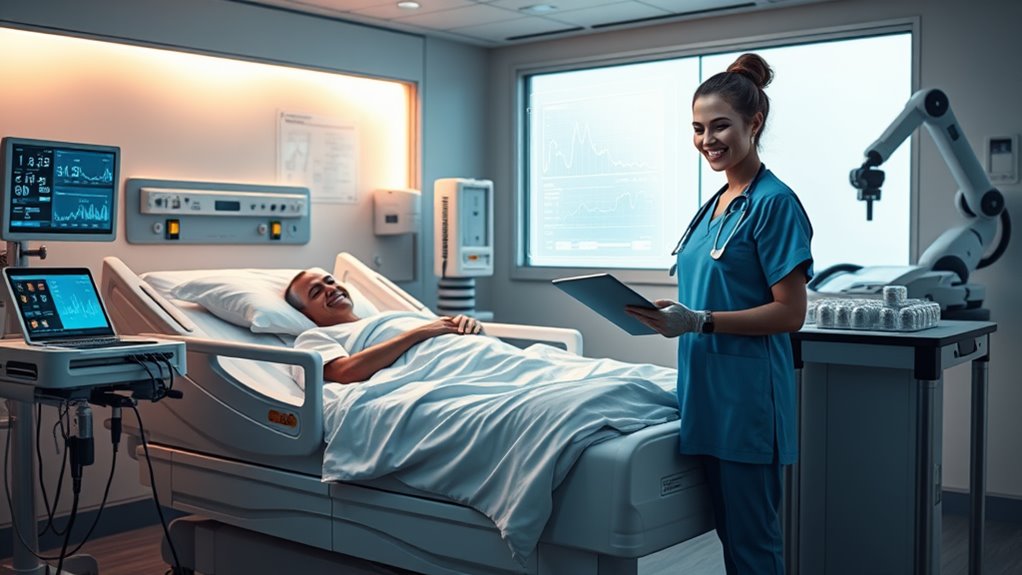
Technology is revolutionizing healthcare by making it more accessible, efficient, and patient-centered. Telemedicine allows remote consultations, improving access for underserved populations. Wearable devices provide real-time health monitoring, enabling proactive health management. Artificial Intelligence improves diagnostic accuracy and efficiency by analyzing vast datasets. Innovations in surgical techniques and robotics provide precision as they reduce recovery times. Additionally, mobile health applications and patient engagement tools empower individuals in their healthcare experiences. As technology continues to evolve, it promotes a culture of collaboration, ultimately transforming patient care. Discover how these advancements shape the future of healthcare and what lies ahead.
Telemedicine Advancements
In recent years, advancements in telemedicine have transformed the terrain of healthcare delivery, enabling patients to access medical services from the comfort of their homes. This evolution has empowered both patients and healthcare providers, allowing for efficient management of health concerns as well as minimizing the barriers traditionally associated with in-person visits. The integration of remote consultations has changed the patient experience, facilitating timely interventions and promoting a proactive approach to healthcare.
Remote consultations have emerged as an influential tool, enabling healthcare professionals to diagnose and treat patients effectively, regardless of geographical constraints. Physicians can conduct virtual check-ups, ensuring that patients receive the necessary care without the need for physical presence. This not only improves patient satisfaction but likewise optimizes the allocation of healthcare resources, allowing practitioners to extend their reach and impact.
Furthermore, the rise of telemedicine has catalyzed a shift in the healthcare paradigm, emphasizing accessibility and convenience. With the ability to connect with specialists across various disciplines through secure digital platforms, patients are no longer confined to local expertise. This democratization of healthcare is particularly significant for individuals in rural or underserved areas, where access to quality medical care has historically been limited.
As telemedicine continues to evolve, it is poised to disrupt traditional healthcare models, paving the way for a more agile and responsive healthcare system. The future of healthcare delivery lies in the seamless integration of technology, ensuring that every individual can obtain the care they need, whenever they need it.
Wearable Health Technology
Wearable health technology has gained significant traction in recent years, with millions of individuals adopting devices that monitor various health metrics in real time. These innovative wearable devices enable users to take charge of their health by providing critical insights into heart rate, sleep patterns, physical activity, and more. As the demand for personalized healthcare solutions grows, the integration of these technologies into daily life has become a formidable tool for both individuals and healthcare providers.
Wearable health technology not only promotes self-awareness but additionally facilitates the collection of valuable health data. This data can be used to track progress, identify trends, and make informed decisions regarding lifestyle changes or medical interventions. Moreover, the ability to share this information with healthcare professionals improves patient-provider communication, leading to more customized treatment plans and enhanced health outcomes.
The impact of these devices extends beyond individual users; they contribute to a broader comprehension of population health. Aggregated health data from wearable devices can reveal patterns that inform public health initiatives and policy-making, eventually transforming the healthcare environment. As organizations leverage this data for research and development, the potential for groundbreaking advancements in preventive care and chronic disease management becomes evident.
Artificial Intelligence in Diagnostics
Artificial Intelligence (AI) is revolutionizing the field of diagnostics by enhancing accuracy and efficiency in identifying medical conditions. The integration of sophisticated diagnostic algorithms, driven by machine learning, is transforming how healthcare professionals approach patient evaluations. By leveraging vast amounts of data, AI systems can detect patterns and anomalies that may elude the human eye, greatly reducing the likelihood of misdiagnosis.
Machine learning models are trained on diverse datasets, allowing them to continuously improve their diagnostic capabilities. This dynamic learning process guarantees that AI remains at the forefront of medical advancements, adapting to new information and evolving healthcare paradigms. For instance, AI-driven tools can analyze imaging studies, such as X-rays and MRIs, with remarkable precision, often outperforming traditional methods. This not only expedites the diagnostic process but additionally enables clinicians to make informed decisions swiftly.
Moreover, the deployment of AI in diagnostics extends beyond imaging. From predicting disease outbreaks to identifying genetic disorders, AI's versatility is reshaping the environment of personalized medicine. As healthcare systems increasingly adopt these technologies, the potential for early intervention and customized treatment plans will become a formidable asset, enhancing patient outcomes and optimizing resource allocation.
Electronic Health Records
The implementation of Electronic Health Records (EHRs) is a vital advancement in modern healthcare, complementing the innovations brought by Artificial Intelligence in diagnostics. EHRs serve as a digital backbone, enabling healthcare providers to access thorough patient data swiftly, thereby enhancing clinical decision-making and patient outcomes. Nonetheless, their widespread adoption is not without challenges, particularly regarding interoperability and data privacy.
Interoperability challenges arise when different EHR systems struggle to communicate effectively. This fragmentation can lead to inefficiencies, as healthcare professionals may have to navigate multiple systems to retrieve crucial patient information. Addressing these challenges is imperative for achieving seamless care coordination across various healthcare settings.
Data privacy remains a paramount concern as well. With the digitization of sensitive health information, safeguarding patient data from potential breaches becomes a critical responsibility for healthcare organizations. Implementing robust security measures and compliance with regulations such as HIPAA is vital for maintaining patient trust and ensuring that data remains confidential.
| Challenge | Description |
|---|---|
| Interoperability | Difficulty in systems communicating effectively |
| Data Privacy | Risks related to unauthorized access |
| User Adoption | Resistance from professionals to new systems |
Mobile Health Applications
Mobile health applications are transforming patient engagement by providing users with convenient access to their health information and resources. These tools facilitate improved health monitoring, allowing individuals to track their conditions in real-time and share data with healthcare providers. As a result, mobile health applications are becoming integral to promoting proactive health management and improving overall patient outcomes.
Increased Patient Engagement
Numerous studies highlight the transformative impact of mobile health applications on patient engagement in healthcare. These applications empower individuals by improving patient education, providing vital information at their fingertips. As patients become more informed, they are better equipped to make decisions regarding their health and treatment options.
| Feature | Description | Impact on Engagement |
|---|---|---|
| Patient Education Tools | Resources and articles to facilitate comprehension | Informed patients make better choices |
| Feedback Mechanisms | Channels for patients to communicate with providers | Encourages dialogue and trust |
| Appointment Reminders | Notifications to guarantee adherence to schedules | Reduces no-show rates and improves outcomes |
Mobile health applications cultivate a two-way interaction between patients and healthcare providers, promoting a collaborative environment vital for effective care. Feedback mechanisms embedded within these applications allow for real-time communication, enabling providers to quickly address patient concerns. This integration not just improves satisfaction but also nurtures a sense of ownership among patients regarding their health experience. In the evolving environment of healthcare, leveraging technology to improve patient engagement is not merely advantageous; it is essential for achieving ideal health outcomes.
Enhanced Health Monitoring
Building upon the foundation of increased patient engagement, mobile health applications have greatly improved health monitoring capabilities. These applications empower healthcare providers and patients alike by facilitating remote patient monitoring, thereby transcending traditional healthcare barriers. Patients can now continuously track their health metrics, enabling timely interventions that can greatly mitigate potential complications.
The integration of biometric data analysis within these applications improves the precision of health assessments. By capturing and analyzing essential signs, such as heart rate, blood pressure, and glucose levels, healthcare professionals gain invaluable insights into their patients' conditions. This data-driven approach not only promotes proactive health management but also supports personalized treatment plans customized to individual needs.
Moreover, the real-time feedback provided by these applications enables patients to take control of their health, creating a symbiotic relationship between technology and patient autonomy. This paradigm shift represents a formidable evolution in healthcare, as mobile health applications drive efficiency, improve outcomes, and ultimately redefine the patient experience. As we utilize the full potential of these technologies, the future of healthcare stands poised for an unprecedented transformation.
Robotics in Surgery
Robotics in surgery represents a significant advancement in medical technology, offering improved precision and accuracy that traditional methods may lack. These innovations facilitate minimally invasive techniques, resulting in reduced recovery times and lower risk of complications for patients. As the field continues to evolve, the integration of robotic systems is poised to redefine surgical practices and improve patient outcomes.
Enhanced Precision and Accuracy
In the domain of surgical procedures, the integration of advanced robotics has considerably transformed the environment of precision and accuracy. Surgeons now wield improved capabilities, allowing them to perform complex operations with unparalleled dexterity and focus. This technological evolution is not solely a trend; it represents a seismic shift in how surgical outcomes are achieved.
Robotic systems enable real-time data integration, including insights from genetic testing, which can inform decisions regarding personalized medicine. By comprehending a patient's unique genetic makeup, surgeons can tailor procedures that optimize safety and efficacy, thereby minimizing risks and improving recovery times. The precision afforded by robotics guarantees that even the most intricate maneuvers are executed with millimeter accuracy, drastically reducing the likelihood of complications.
Moreover, the ability to visualize surgical sites with augmented clarity allows for more informed decision-making during operations. This synergy between robotics and genetic insights epitomizes the future of surgical intervention, where technology not only supports but amplifies human skill. The ultimate objective is to deliver superior patient outcomes and redefine the standards of excellence in healthcare. As we move forward, the relentless pursuit of precision in surgery will remain at the forefront of medical innovation.
Minimally Invasive Techniques
Minimally invasive techniques have transformed surgical practices, allowing for procedures that require only small incisions rather than large openings. This revolutionary approach leverages robotic assistance, improving the surgeon's capabilities through advanced technology. With the precision afforded by robotic systems, surgeons can navigate intricate anatomical structures with unparalleled accuracy, minimizing trauma to surrounding tissues.
The benefits of these techniques extend beyond the operating room. Patients experience considerably reduced postoperative pain and lower risk of complications, leading to expedited recovery times. Traditional surgeries often necessitate prolonged hospital stays; yet, minimally invasive procedures typically enable patients to return home within a day. This not only improves the patient experience but also optimizes healthcare resource management.
The integration of robotics in surgery not only empowers surgeons but also establishes a new standard of care. As healthcare continues to evolve, the adoption of minimally invasive techniques signals a substantial shift in the direction of efficiency and effectiveness. By embracing these advancements, healthcare providers position themselves at the forefront of surgical innovation, ultimately transforming patient outcomes and redefining the environment of modern medicine. The future of healthcare is decidedly aligned with the precision and efficiency brought forth by robotic-assisted minimally invasive surgery.
Big Data Analytics
The integration of big data analytics into healthcare has transformed the way medical professionals approach patient care and operational efficiency. By utilizing vast amounts of data, healthcare providers can make informed decisions that improve patient outcomes and streamline processes. Predictive modeling, a cornerstone of big data analytics, enables clinicians to anticipate patient needs, identify potential risks, and implement preventative measures before issues escalate. This proactive approach fundamentally shifts the paradigm, allowing for customized treatment plans that align with individual patient profiles.
Moreover, data visualization tools play a pivotal role in translating complex datasets into actionable insights. By presenting data in a clear and intuitive format, healthcare stakeholders can quickly grasp trends and patterns that inform strategic decisions. For instance, visual dashboards can reveal patient flow dynamics, resource utilization, and treatment efficacy, enabling administrators to optimize operations and allocate resources judiciously.
In an era where data is abundant, the ability to leverage big data analytics is not just an advantage; it is a necessity for healthcare organizations seeking to maintain competitive supremacy. By nurturing a culture of data-driven decision-making, institutions can improve their agility and responsiveness to the constantly changing healthcare environment.
Ultimately, big data analytics is not merely a tool; it is a significant catalyst for innovation and excellence in healthcare. As organizations continue to embrace these advanced methodologies, the potential for improved patient care and operational excellence becomes increasingly attainable, solidifying the role of healthcare as a leader in the digital age.
Cloud Computing Solutions
Healthcare's reliance on cloud computing solutions has transformed the storage, management, and sharing of patient data. By utilizing the strength of cloud storage, healthcare organizations can efficiently store vast amounts of sensitive information, allowing for seamless access across various departments and locations. This improved accessibility not only streamlines operations but also boosts the quality of patient care, as healthcare professionals can retrieve critical information in real-time.
Moreover, cloud computing solutions enable healthcare providers to leverage advanced data analytics, driving informed decision-making and operational efficiencies. The scalability of cloud infrastructure guarantees that organizations can adapt to the evolving environment of healthcare demands, accommodating everything from increased patient loads to the integration of emerging technologies.
However, as the volume of data continues to surge, data security remains paramount. Robust cloud computing solutions implement state-of-the-art security protocols, guaranteeing that patient data is protected against breaches and unauthorized access. Healthcare organizations must prioritize selecting cloud service providers that comply with stringent regulatory standards, such as HIPAA, to safeguard sensitive information.
Patient Engagement Tools
Empowering patients to take charge of their health has become a central focus in modern healthcare, with patient engagement tools playing a pivotal role in this transformation. These tools are designed to cultivate active participation, enabling patients to navigate their healthcare experiences with confidence and authority. By leveraging technology, healthcare providers can create interactive platforms that facilitate communication, education, and self-management, thereby improving the overall patient experience.
One of the most influential aspects of patient engagement tools is their ability to gather and utilize patient feedback. This feedback is instrumental in refining healthcare services and tailoring them to meet the diverse needs of patients. When patients feel heard and valued, their engagement deepens, resulting in improved health outcomes and satisfaction levels. Moreover, the incorporation of interactive platforms allows for real-time communication between patients and providers, nurturing a collaborative environment that empowers patients to take ownership of their health decisions.
As patients engage with these tools, they gain access to personalized health information, allowing them to make informed choices regarding their treatment options. In addition, gamification elements within these platforms can motivate patients to adhere to treatment plans and participate in preventive care measures. Ultimately, the integration of patient engagement tools into healthcare systems is not just an improvement; it is a fundamental shift that raises the patient experience, ensuring that individuals are not passive recipients of care, but active participants in their health experiences.
Virtual Reality Treatment
Numerous studies have demonstrated the transformative potential of virtual reality (VR) in the treatment of various medical conditions. By creating immersive experiences that engage patients in a multidimensional manner, VR has emerged as a formidable tool in the domain of mental health. This state-of-the-art technology provides patients with the ability to confront their fears, manage pain, and improve rehabilitation processes through controlled exposure to therapeutic environments.
The following table illustrates the key applications of VR in healthcare:
| Application | Description |
|---|---|
| Phobia Treatment | Gradual exposure to fear-inducing stimuli in a safe environment. |
| Pain Management | Distraction techniques that reduce the perception of pain. |
| Cognitive Rehabilitation | Interactive tasks to improve cognitive functions post-injury. |
| Stress Relief | Guided relaxation and mindfulness exercises in calming virtual settings. |
These immersive experiences are not merely innovative; they empower patients to take an active role in their healing experience. By immersing individuals in customized environments, VR facilitates profound shifts in emotional and psychological states, ultimately improving overall treatment efficacy. The future of healthcare lies in embracing such technologies, as they not only transform treatment protocols but also redefine the patient experience. As healthcare professionals utilize the capabilities of VR, they are not merely adapting to change; they are leading an evolution in mental health treatment that promises to deliver unparalleled outcomes.
Cybersecurity in Healthcare
Protecting sensitive patient information has become a critical priority in the healthcare sector as cyber threats continue to evolve. The rise of digital health records and interconnected systems has created a fertile ground for malicious actors to exploit vulnerabilities, leading to alarming rates of data breaches. Healthcare organizations must recognize that the stakes are not just financial; the integrity of patient privacy hangs in the balance, impacting trust and care delivery.
To combat these challenges, healthcare leaders must adopt a multifaceted approach to cybersecurity. This includes implementing advanced encryption protocols, conducting regular security audits, and promoting a culture of cybersecurity awareness among staff. Training employees to identify phishing attempts and other deceptive practices is crucial, as human error remains one of the most significant risks in data protection.
Moreover, leveraging artificial intelligence and machine learning can improve threat detection capabilities, allowing organizations to respond proactively rather than reactively. By employing these technologies, healthcare providers can safeguard sensitive information and guarantee compliance with stringent regulations such as HIPAA, which mandates the protection of patient privacy.
Frequently Asked Questions
How Does Tech Improve Healthcare Access in Rural Areas?
In the vast expanse of rural environments, technology serves as a beacon of hope, illuminating pathways to healthcare access. Telehealth services bridge geographical divides, enabling remote consultations that empower patients with timely medical advice. Coupled with mobile clinics, these innovations guarantee that essential healthcare reaches even the most isolated communities. This harmonious integration of technology not merely improves accessibility but additionally cultivates a sense of community resilience, in the end transforming the health narrative in rural areas.
What Are the Challenges of Implementing Tech in Healthcare Systems?
Implementing technology in healthcare systems presents several challenges, particularly data security and user training. Ensuring the protection of sensitive patient information is paramount, as breaches can undermine trust and compliance. Furthermore, effective user training is crucial to maximize the benefits of new technologies; inadequate training can lead to inefficiencies and errors. Organizations must strategically address these issues to leverage the full potential of technological advancements as they protect their operations and patient welfare.
How Do Patients Feel About Privacy in Tech-Enabled Healthcare?
Patients often grapple with a profound sense of vulnerability regarding privacy in tech-enabled healthcare. As they relinquish personal data, concerns about data security and the adequacy of patient consent emerge. The anxiety surrounding unauthorized access to sensitive information can overshadow the potential benefits of innovation. Empowering patients with transparent policies and strong security measures is vital, as it nurtures trust and guarantees that individuals feel in control of their healthcare data in an increasingly digital environment.
What Is the Cost Impact of Tech Innovations on Healthcare?
The cost impact of technological innovations in healthcare is significant, driving both cost savings and improved investment returns. Advanced technologies streamline operations, reduce administrative burdens, and enhance patient outcomes, which collectively lead to lower overall expenditures. Furthermore, the initial investment in tech solutions often yields substantial long-term financial benefits, as healthcare organizations experience increased efficiency and patient satisfaction. As a result, strategic adoption of technology is crucial for optimizing fiscal performance within the healthcare sector.
How Can Tech Bridge Language Barriers in Patient Care?
Tech can greatly bridge language barriers in patient care by employing advanced translation services and multilingual apps. These tools facilitate real-time communication between healthcare providers and patients who speak different languages, ensuring accurate information exchange and enhancing patient comprehension. By integrating these technologies into healthcare systems, organizations can promote inclusivity, reduce miscommunication, and in the end improve patient outcomes. Embracing such innovations positions healthcare providers at the forefront of effective and equitable patient engagement.
