
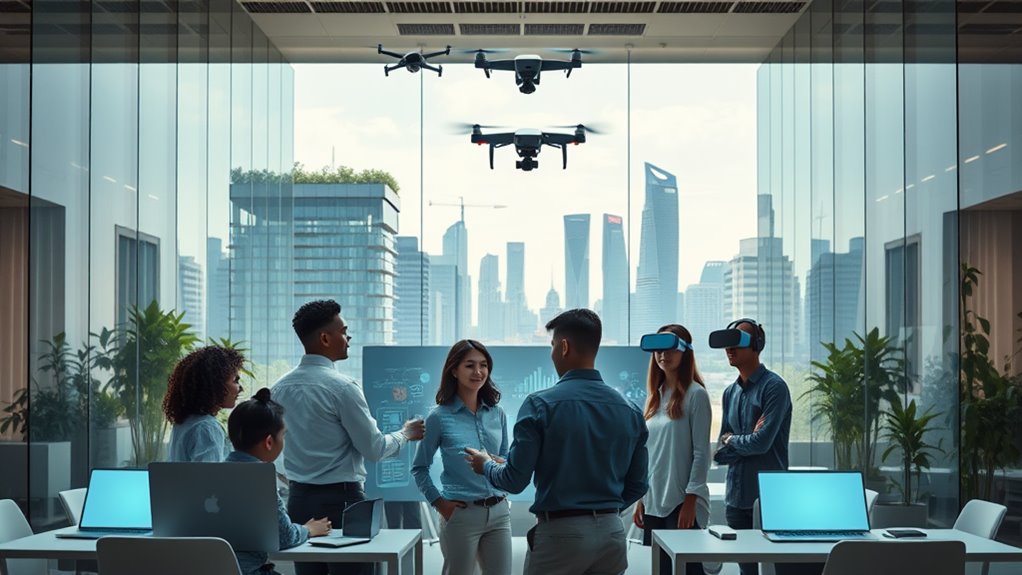
The future of work is being profoundly transformed by emerging technologies and the dynamics of remote work. AI and virtual collaboration tools improve productivity by streamlining communication and enabling real-time data analysis. This shift promotes flexibility and a balanced work-life environment, attracting diverse talent worldwide. Nevertheless, the rise of automation poses challenges, necessitating reskilling to adapt to evolving job roles. Furthermore, nurturing diversity and inclusion improves team dynamics and innovation. As organizations navigate these changes, comprehending the implications is vital for success in this tech-driven environment. There's much more to explore about these trends and their effects on the workforce.
Emerging Technologies Transforming Work
Emerging technologies are reshaping the environment of work, driving efficiency and innovation across various industries. In this dynamic setting, organizations are increasingly utilizing AI collaboration tools and virtual reality (VR) environments to improve productivity and cultivate creativity. These technological advancements are not solely trends; they represent a paradigm shift in how businesses operate and engage their workforce.
AI collaboration tools enable teams to utilize machine intelligence, augmenting human capabilities to achieve unparalleled outcomes. By streamlining communication and automating repetitive tasks, these solutions allow professionals to focus on strategic decision-making and high-value activities. The integration of AI into daily operations is a game-changer, allowing for real-time data analysis and predictive insights that improve overall performance.
Simultaneously, virtual reality is redefining the way individuals experience training and development, enabling immersive learning experiences that transcend geographical boundaries. In corporate settings, VR facilitates realistic simulations, allowing employees to practice skills in a safe environment before applying them in real-world scenarios. This innovative approach not only accelerates learning but also promotes a deeper comprehension of complex concepts.
As organizations embrace these emerging technologies, they position themselves at the forefront of industry evolution. The ability to adapt and integrate AI collaboration and virtual reality into the workplace is critical for leaders seeking to maintain a competitive edge. In the end, the future of work hinges on the strategic adoption of these influential tools, which promise to transform productivity and redefine the essence of collaboration in the modern workforce.
The Rise of Remote Work
The rise of remote work has transformed the employment environment, offering significant benefits such as increased flexibility and access to a broader talent pool. Nonetheless, this shift likewise presents challenges, including potential isolation and difficulties in collaboration. As we explore future trends in telecommuting, it is crucial to evaluate both the advantages and obstacles that remote work entails.
Benefits of Remote Work
Remote work has transformed the traditional employment environment, offering numerous advantages for both employees and employers. One of the most significant benefits is the improvement of work-life balance, allowing individuals to tailor their schedules to meet personal and professional commitments. This flexibility promotes increased productivity, as employees can work during their peak performance hours, unhindered by the constraints of a rigid office environment.
For employers, remote work offers substantial cost savings through reduced overhead expenses and the ability to attract talent from a global workforce. This expanded talent pool boosts employee satisfaction, as companies can hire individuals who resonate with their organizational culture, regardless of geographic limitations. Moreover, the ability to implement flexible schedules accommodates diverse time zones, enabling teams to collaborate seamlessly across borders.
The environmental impact of remote work cannot be overlooked. Reduced commuting lowers carbon footprints, contributing to a more sustainable future. Additionally, remote work promotes health benefits by minimizing exposure to illness and cultivating a more comfortable work environment. As organizations embrace this paradigm shift, the strategic advantages of remote work will certainly shape the future of work in a tech-driven world.
Challenges of Remote Work
Even though the benefits of remote work are significant, several challenges accompany this shift that can impact both employees and organizations. One of the foremost issues is the communication barriers that arise in a virtual environment. Without face-to-face interaction, nuances can be lost, leading to misunderstandings and reduced collaboration. In addition, the absence of physical proximity can hinder team cohesion, making it difficult for teams to bond and build trust.
To illustrate these challenges, the following table outlines common issues faced by remote teams:
| Challenge | Description | Impact on Team |
|---|---|---|
| Communication Barriers | Misinterpretation of messages and lack of clarity | Reduced efficiency |
| Isolation | Employees may feel disconnected from colleagues | Decreased morale |
| Collaboration Tools | Ineffective use of technology for remote work | Hindered productivity |
| Time Zone Differences | Scheduling difficulties across locations | Delayed decision-making |
Addressing these challenges requires proactive strategies, including encouraging open lines of communication, leveraging technology effectively, and promoting inclusivity within remote teams. Organizations that navigate these obstacles with foresight will position themselves for sustained success in this evolving work environment.
Future Trends in Telecommuting
Increasingly, organizations are embracing telecommuting as a long-term strategy rather than a temporary solution. This paradigm shift is fueled by the necessity for flexibility, efficiency, and access to a global talent pool. As companies recognize the myriad benefits of remote work, the implementation of advanced virtual collaboration tools becomes paramount. These tools facilitate seamless connectivity among teams, enabling organizations to maintain productivity regardless of physical location.
Furthermore, asynchronous communication methods are gaining traction as a critical component of this new work environment. Such methodologies allow team members to engage on their own schedules, reducing the pressure of real-time interactions and encouraging a more thoughtful exchange of ideas. This flexibility not only empowers employees but in addition improves overall performance, driving innovation and creativity.
As we look to the future, the synthesis of these technologies will redefine organizational structures, promoting a culture that prioritizes results over traditional office presence. Leaders who utilize the potential of telecommuting will position their organizations at the forefront of this evolution, ensuring resilience and competitiveness in an increasingly digital world. The rise of remote work is not simply a trend; it is a transformative force reshaping the future of work itself.
Skills for the Future
As the terrain of employment evolves in response to technological advancements, the demand for specific skills has become significant. In this swiftly changing environment, professionals must cultivate competencies that not only improve personal efficacy but additionally position them as leaders in their fields. Two important skills that stand out are digital literacy and critical thinking. Digital literacy transcends mere familiarity with technology; it encompasses the ability to navigate complex digital settings, analyze information critically, and leverage tools for strategic decision-making. Meanwhile, critical thinking encourages innovative problem-solving and enables professionals to dissect challenges, formulate actionable strategies, and drive organizational success.
To effectively navigate the future of work, individuals should consider the following fundamental skills:
| Skill Category | Description | Importance |
|---|---|---|
| Digital Literacy | Mastery of digital tools and platforms | Fundamental for efficient communication and collaboration in a tech-driven environment. |
| Critical Thinking | Ability to analyze, evaluate, and create | Significant for informed decision-making and encouraging innovation within organizations. |
| Emotional Intelligence | Comprehension and management of emotions | Essential for leadership and teamwork in increasingly collaborative environments. |
| Adaptability | Capacity to adjust to changing environments | Key to thriving amidst swift technological advancements and evolving workforce dynamics. |
Impact of Automation
The rise of automation is reshaping the workforce environment, introducing both opportunities and challenges that demand a reevaluation of existing skills. As businesses increasingly adopt advanced technologies, the environment of employment is evolving, compelling leaders to navigate the precarious balance between job displacement and productivity improvement.
Automation, as it streamlines operations and drives efficiency, inevitably results in the displacement of certain job categories. Roles that are repetitive or routine in nature are particularly vulnerable, as machines and software can execute tasks with greater speed and accuracy. This scenario poses significant challenges for a workforce that must adapt or risk obsolescence. Organizational leaders must take proactive measures to mitigate the impacts of job displacement by investing in reskilling and upskilling initiatives. This not merely safeguards employee potential but also reinforces the company's competitive advantage in a swiftly changing market.
Conversely, the potential for productivity improvement through automation cannot be understated. By reallocating human resources to more strategic and creative tasks, organizations can promote innovation and drive growth. The integration of automation can lead to improved operational efficiency, allowing businesses to focus on value-added activities that distinguish them from competitors.
Ultimately, the impact of automation is a double-edged sword. The challenge lies in utilizing its benefits while addressing the inevitable disruptions it brings. To thrive in this tech-driven world, organizations must embrace a forward-thinking approach that prioritizes skill development and strategic workforce planning. Through this lens, the future of work can be envisioned as an environment marked by resilience and opportunity.
Workplace Diversity and Inclusion
Workplace diversity and inclusion are vital components of a thriving organizational culture, greatly enhancing team performance and innovation. Diverse teams bring varied perspectives that can lead to more creative solutions and improved decision-making processes. To utilize these benefits, organizations must implement effective strategies that cultivate an inclusive environment for all employees.
Benefits of Diverse Teams
Diverse teams bring a wealth of perspectives and experiences that can propel innovation and improve problem-solving capabilities within an organization. By utilizing cognitive diversity, these teams cultivate dynamic interactions that elevate team dynamics and lead to more effective decision-making. Varied cultural perspectives enable organizations to explore innovative solutions that resonate with a global audience, ultimately driving competitive advantage.
The benefits of diverse teams extend beyond mere creativity boosts; they improve employee engagement by creating an inclusive environment where individuals feel valued and heard. This heightened engagement translates into increased motivation and productivity, empowering teams to tackle complex challenges with vigor. Additionally, the variety of backgrounds and experiences facilitates knowledge sharing, enriching the collective intelligence of the team.
Effective conflict resolution arises naturally in diverse teams, as differing viewpoints encourage open dialogue and constructive debate, leading to well-rounded outcomes. Organizations that capitalize on the strengths of diverse teams position themselves to adapt swiftly to change, continuously innovating and meeting the demands of a constantly changing marketplace. The future of work hinges on embracing these benefits, ensuring that diverse teams are not just a goal, but a strategic imperative.
Strategies for Inclusion
Nurturing an inclusive environment requires intentional strategies that go beyond surface-level diversity initiatives. Organizations seeking to thrive in a tech-driven world must embrace inclusive leadership as a cornerstone of their culture. Leaders must actively engage with diverse voices, cultivating an atmosphere where every employee feels valued and empowered to contribute.
Equitable policies are crucial to dismantling systemic barriers that hinder inclusion. An assessment of current practices should reveal gaps in representation and opportunities for underrepresented groups. Implementing mentorship programs and customized professional development initiatives can improve pathways to leadership roles for diverse talent.
Furthermore, embracing technology can facilitate inclusivity. Tools designed for collaboration and feedback can guarantee that all employees, regardless of their background, have a platform to share ideas and perspectives.
Regular evaluation of inclusion strategies is critical. Organizations should establish metrics to gauge progress and refine approaches based on feedback. By prioritizing these strategies, companies not only improve their workplace culture but additionally drive innovation and engagement, positioning themselves as leaders in the competitive arena of the future. In the end, a commitment to genuine inclusion reflects a strong organizational ethos that attracts top talent and nurtures sustainable success.
Adapting to Change
In today's swiftly changing environment, organizations must embrace the reality that change is a constant force shaping the future of work. To thrive amidst this perpetual flux, companies need robust change management frameworks that not just facilitate alterations but also strengthen organizational resilience. A proactive approach to adapting to change empowers businesses to seize opportunities rather than merely react to challenges.
Key components of effective adaptation include:
- Clear Communication: Ensuring that all stakeholders are informed and engaged promotes a culture of transparency and trust.
- Continuous Learning: Encouraging ongoing training and development equips employees with the skills necessary to navigate new technologies and methodologies.
- Agility and Flexibility: Implementing agile practices allows organizations to pivot quickly in response to market demands and technological advancements.
- Empowerment and Involvement: Inviting employees to contribute to change initiatives not just improves buy-in but also leverages diverse perspectives for innovative solutions.
Incorporating these elements into change management strategies is crucial for cultivating a resilient organization. Embracing change as an opportunity rather than an impediment positions companies to thrive in an unpredictable environment. As we advance into a tech-driven future, the ability to adapt will distinguish leaders from laggards. Organizations that prioritize change management and nurture a culture of resilience will not just survive but excel, revealing their true potential in a constantly shifting world.
Frequently Asked Questions
How Will Tech Affect Job Satisfaction in the Future?
The integration of technology is poised to markedly influence job satisfaction, primarily through improved job autonomy and increased employee engagement. As automation and digital tools streamline processes, employees may experience greater flexibility in their roles, empowering them to take ownership of their work. This autonomy can lead to higher motivation and commitment. Additionally, technology facilitates real-time feedback and collaboration, nurturing a more engaged workforce, eventually improving overall job satisfaction and organizational performance.
What Role Do Soft Skills Play in Tech-Driven Workplaces?
In today's swiftly changing workplaces, the intersection of technology and human interaction underscores the crucial role of soft skills. Acquiring communication skills promotes clarity amidst complex digital tools, whereas emotional intelligence improves interpersonal relationships. As teamwork dynamics shift, adaptability training becomes fundamental, enabling professionals to navigate unforeseen challenges seamlessly. In the end, utilizing these soft skills empowers individuals to not just thrive in their roles but additionally to drive organizational success in an increasingly automated environment.
How Can Companies Ensure Employee Well-Being in Remote Settings?
To guarantee employee well-being in remote settings, companies must prioritize robust strategies that improve employee engagement and support mental health. Implementing regular check-ins, encouraging open communication, and providing access to mental health resources are crucial. Furthermore, promoting a culture of recognition and collaboration can mitigate feelings of isolation. By investing in these initiatives, organizations empower their workforce, ultimately driving productivity and retention in an increasingly remote work environment.
What Are the Environmental Impacts of Increased Remote Work?
As the surge in remote work blossoms like a resilient flower in spring, it brings both promise and peril for our environment. Although digital nomadism can greatly reduce the carbon footprint by minimizing commutes and office energy consumption, the increased reliance on technology can lead to heightened electronic waste and energy demands. Companies must navigate this duality, adopting sustainable practices to utilize the benefits of remote work as they mitigate its ecological consequences.
How Will Tech Shape Leadership Roles in the Future?
Technology will markedly shape leadership roles by nurturing digital leadership and adaptive management. Leaders must embrace technological advancements to improve decision-making and operational efficiency. As organizations increasingly rely on data-driven insights, leaders will need to cultivate a mindset that values agility and innovation. This transformation will require them to develop competencies that leverage technology, enabling them to navigate complex challenges and empower their teams to thrive in a swiftly changing environment.
