
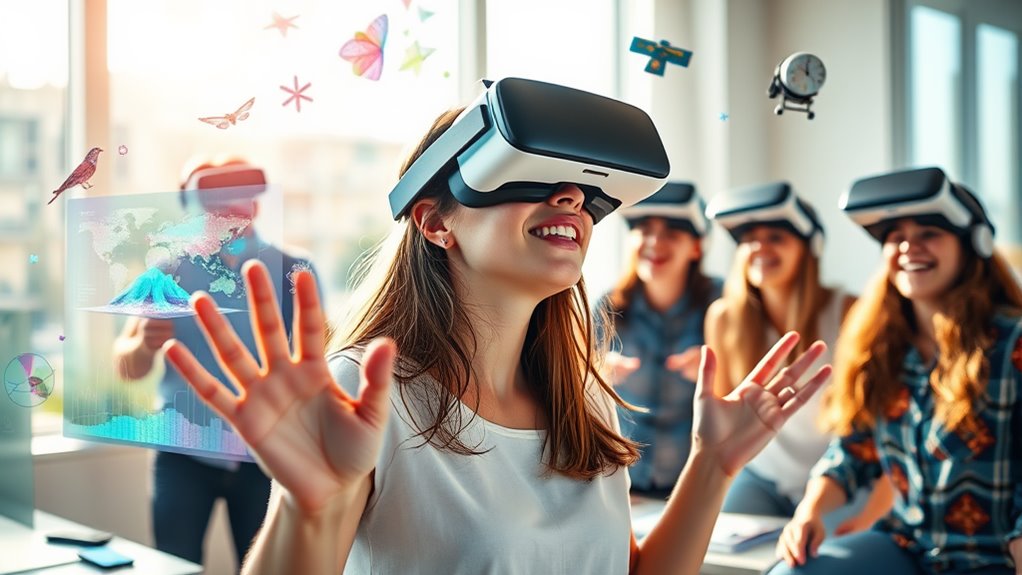
Virtual reality is transforming how we work and play by providing immersive experiences that improve both collaboration and learning. In the workplace, VR promotes effective communication and team dynamics, particularly in remote settings. It offers risk-free environments for training and skill development, promoting higher retention rates. In leisure, VR boosts gaming through participatory storytelling and social interaction. Moreover, it encourages immersive leisure activities that benefit workplace growth. Organizations embracing VR position themselves for increased productivity and innovation. Exploring further reveals the profound implications of this technology on our daily lives and future work environments.
Overview of Virtual Reality
Virtual reality (VR) represents a transformative technological frontier that immerses users in digitally created environments, enabling interaction with 3D spaces as if they were real. This groundbreaking technology is increasingly influential across various sectors, reshaping how we engage with diverse content and experiences. The rise of virtual reality applications is not merely a trend; it is a fundamental shift that empowers individuals and organizations to explore new domains of possibility. From education and healthcare to entertainment and business, VR is revolutionizing the way we learn, heal, work, and play. As its applications expand, more people are falling in love with VR, captivated by its ability to transport them to entirely new worlds and experiences. This deepening engagement underscores the technology’s potential to redefine human interaction and reshape industries on a global scale.
One of the most compelling aspects of VR is its capacity for immersive storytelling, where users are not just passive recipients of narratives but active participants in the unfolding drama. This level of engagement captivates audiences, nurturing a deeper emotional connection with the content. By placing users at the heart of the experience, VR transforms traditional storytelling into a multi-sensory expedition that can augment learning, training, and entertainment in unparalleled ways.
Moreover, VR extends its influence beyond entertainment, finding applications in education, healthcare, and marketing. These applications leverage the immersive nature of VR to facilitate complex simulations, allowing users to practice skills or navigate scenarios that would be difficult or impossible in the real world. As organizations recognize the profound impact of VR on learning and engagement, they are increasingly adopting these technologies to gain a competitive edge.
In essence, virtual reality is more than just a technological innovation; it is a significant tool that allows users to transcend physical limitations, engage deeply with content, and access new potential in both personal and professional domains.
Virtual Reality in the Workplace
Virtual reality is transforming the workplace by offering improved training experiences that allow employees to acquire skills in immersive environments. Furthermore, virtual collaboration tools are enabling teams to connect and work together seamlessly, regardless of geographical barriers. These advancements not only boost productivity but likewise nurture innovation within organizations.
Enhanced Training Experiences
Employers are increasingly recognizing the transformative potential of immersive technologies in enhancing training experiences within the workplace. Virtual reality (VR) stands at the forefront of this revolution, offering unparalleled opportunities to engage employees through virtual simulations that replicate real-world scenarios. These sophisticated training modules allow individuals to practice skills in a risk-free environment, considerably reducing the likelihood of costly errors during actual operations.
The use of VR in training not merely boosts employee engagement but additionally provides organizations with the means to conduct thorough skill assessments. By tracking performance in virtual settings, employers can gain insights into an employee's capabilities and areas for improvement, promoting a culture of continuous development. This data-driven approach empowers management to tailor training programs to meet specific needs, eventually enhancing productivity and effectiveness.
Moreover, the immersive nature of VR guarantees that learning is not just theoretical but experiential, allowing employees to internalize critical concepts through active participation. As companies utilize the strength of VR, they position themselves at the cutting edge of innovation, ready to nurture a workforce that is skilled, adaptable, and equipped to navigate the intricacies of modern industry.
Virtual Collaboration Tools
The integration of immersive technologies extends beyond training to transform collaboration within the workplace. Virtual reality (VR) is revolutionizing how teams engage, promoting improved communication and productivity through virtual meetings that simulate physical presence. This shift not just empowers individuals but additionally reshapes team dynamics, enabling seamless collaboration irrespective of geographical barriers.
Key advantages of virtual collaboration tools include:
- Improved Engagement: Immersive environments facilitate active participation, keeping team members focused and involved.
- Real-time Interaction: Virtual meetings allow for immediate feedback and brainstorming sessions, accelerating decision-making processes.
- Increased Creativity: VR tools stimulate innovative thinking by providing unique, interactive spaces for idea generation and problem-solving.
- Cultural Bridge: Diverse teams can collaborate more effectively by promoting comprehension and rapport through shared virtual experiences.
As organizations increasingly adopt these solutions, they can leverage the full potential of their human capital. The result is a potent synergy that not only improves productivity but additionally nurtures a culture of collaboration that is essential in today's competitive environment. Embracing virtual collaboration tools positions companies at the forefront of innovation and operational excellence.
Enhancing Remote Collaboration
As remote work continues to gain prominence, enhancing collaboration among distributed teams becomes crucial. Immersive meeting experiences, real-time collaboration tools, and virtual team-building activities offer innovative solutions to bridge the gap created by physical distance. These technologies not only enable communication but likewise nurture a sense of connection and engagement among team members.
Immersive Meeting Experiences
Collaboration in the digital age often hinges on the effectiveness of meetings, where the challenge of remote communication can hinder productivity and engagement. Immersive meeting experiences, facilitated by virtual reality (VR), provide innovative solutions to these challenges. By cultivating an environment that improves virtual empathy, organizations can greatly enhance the quality of remote interactions.
Key engagement strategies in immersive meetings include:
- Realistic Avatars: Participants can embody lifelike avatars, improving presence and nurturing connections.
- Interactive Environments: Customizable virtual spaces allow teams to collaborate in a more engaging and focused manner.
- Visual Data Sharing: Dynamic 3D models and visual analytics facilitate deeper comprehension and discussion of complex topics.
- Inclusive Participation: Diverse tools enable all voices to be heard, promoting a culture of collaboration and innovation.
These immersive experiences not just break down geographical barriers but create a sense of belonging among team members. As organizations embrace these advanced methodologies, they will find that the synergy of VR and remote collaboration can lead to groundbreaking results, transforming how teams communicate and innovate.
Real-Time Collaboration Tools
Effective remote collaboration increasingly relies on an array of real-time collaboration tools that improve communication and productivity. These tools enable professionals to engage in seamless remote teamwork, breaking down geographical barriers and allowing a new standard of operational efficiency. The integration of advanced platforms facilitates instant messaging, video conferencing, and document sharing, creating a dynamic environment where ideas can flow freely.
Real-time collaboration tools are particularly instrumental during virtual brainstorming sessions, where teams can generate innovative solutions and strategies. Utilizing features such as digital whiteboards and collaborative editing, these platforms allow participants to contribute simultaneously, boosting creativity and encouraging inclusivity. The strength of real-time feedback accelerates decision-making processes, ensuring that projects progress without unnecessary delays.
Moreover, the robust analytics offered by these tools provide valuable insights into team performance, enabling leaders to assess productivity and optimize workflows. By leveraging technology designed for real-time interaction, organizations can improve their collaborative efforts, drive engagement, and eventually achieve superior results. As remote work becomes increasingly prevalent, embracing these influential tools will be vital for any organization aiming for excellence in a competitive environment.
Virtual Team Building Activities
Building strong relationships among remote team members is crucial for nurturing a cohesive work environment. As organizations increasingly adopt virtual frameworks, the need for innovative team bonding activities has never been more critical. Virtual retreats offer an unparalleled opportunity to cultivate synergy and collaboration, empowering teams to operate at their highest potential.
Implementing effective virtual team building activities can yield significant benefits, including:
- Enhanced Communication: Encouraging open dialogue, reducing misunderstandings, and promoting transparency.
- Increased Engagement: Invigorating team morale through enjoyable and interactive experiences that break the monotony of remote work.
- Strengthened Trust: Building rapport and mutual respect among team members, vital for effective collaboration.
- Creative Problem-Solving: Encouraging diverse perspectives through collaborative challenges that stimulate innovation.
Training and Skill Development
Frequently, organizations are turning to virtual reality (VR) as a transformative tool for training and skill development. The capability of VR lies in its ability to create immersive environments that facilitate skill acquisition through interactive simulations. This innovative approach not merely improves hands-on training but likewise accelerates cognitive development by engaging learners in realistic scenarios.
With the rise of remote learning, VR offers unprecedented access to training programs, effectively bridging geographical gaps and ensuring that all employees can participate in skill improvement initiatives. Personalized feedback and real-time assessments further empower learners, enabling them to identify areas for improvement and track their progress effectively.
To illustrate the benefits of VR in training and skill development, consider the following table:
| Aspect | Benefits of VR |
|---|---|
| Skill Acquisition | Accelerates learning through immersion |
| Interactive Simulations | Provides realistic practice environments |
| Hands-on Training | Facilitates practical experience remotely |
| Adaptive Learning | Tailors learning experiences to individual needs |
| Competency Mapping | Aligns skills with career advancement goals |
VR in Education
In the domain of education, virtual reality (VR) is emerging as a formidable tool that improves learning experiences and engagement among students. By utilizing the capabilities of immersive simulations, educators can create dynamic environments that encourage active participation and deeper comprehension of complex subjects. This transformative approach not only boosts retention but also nurtures critical thinking and problem-solving skills among learners.
The integration of VR into educational frameworks presents a plethora of advantages:
- Interactive Learning: Students can engage with materials in ways that traditional methods cannot offer, stimulating curiosity and motivation.
- Real-World Applications: Immersive simulations allow learners to experience real-world scenarios, bridging the gap between theory and practice.
- Collaboration: VR facilitates group activities and projects, encouraging teamwork and communication skills vital for success in modern workplaces.
- Accessibility: Virtual environments can provide equal opportunities for all students, accommodating various learning styles and abilities.
As educational institutions increasingly adopt VR technology, the potential to transform learning environments becomes evident. The capability of immersive simulations can transport students to historical events, complex scientific phenomena, or even distant geographical locations, all from the comfort of their classrooms. This not only enriches the educational experience but also prepares students to thrive in a constantly changing global environment. Ultimately, VR stands as a formidable ally in the quest for improved educational outcomes, positioning learners to excel in both academic and professional endeavors.
Gaming Innovations With VR
With the advent of virtual reality (VR), the gaming industry has witnessed a transformative shift, fundamentally altering how players interact with digital environments. This innovation has not merely improved visual and auditory experiences but also redefined game mechanics, allowing players to immerse themselves in worlds previously constrained by traditional screens. The introduction of VR enables a seamless blend of physical movement and digital interaction, encouraging a sense of presence that captivates players like never before.
One of the most significant developments in VR gaming is the elevation of player engagement. Developers are now able to create experiences where players are not merely observers but active participants. By utilizing motion tracking and haptic feedback, game mechanics have evolved to demand physical involvement, thereby deepening emotional connections and reinforcing strategic decision-making. This shift empowers gamers to explore environments and conquer challenges in a manner that transcends passive gameplay.
Moreover, VR has spurred innovations in narrative design, allowing for personalized story arcs that respond to player choices in real-time. This interactivity not only enriches the gaming experience but also nurtures a unique sense of agency, encouraging a loyal and passionate player base.
As VR technology continues to advance, the potential for groundbreaking innovations in gaming remains limitless. The integration of sophisticated game mechanics and heightened player engagement promises to redefine entertainment, pushing the boundaries of what is achievable and solidifying VR as a formidable force in the gaming arena.
Social Experiences in Virtual Spaces
Social experiences in virtual spaces are transforming the way individuals collaborate and interact in both professional and recreational settings. Collaborative virtual workspaces enable teams to engage in real-time projects, nurturing creativity and communication beyond traditional boundaries. Similarly, immersive gaming environments offer unique opportunities for social interaction, enhancing team dynamics and building relationships in a virtual context.
Collaborative Virtual Workspaces
Transforming the way teams collaborate, collaborative virtual workspaces offer immersive environments where individuals can connect, engage, and innovate regardless of geographical barriers. These state-of-the-art platforms utilize the principles of virtual design to improve team dynamics, nurturing a culture of creativity and productivity.
Key advantages of collaborative virtual workspaces include:
- Improved Communication: Real-time interactions facilitate more effective dialogue, breaking down traditional barriers caused by distance.
- Dynamic Problem Solving: Teams can brainstorm and manipulate virtual objects together, accelerating the innovation process.
- Personalized Environments: Users can tailor their workspace to reflect their style, increasing comfort and engagement.
- Data Visualization: Advanced tools allow teams to present complex data in an interactive format, promoting better comprehension and decision-making.
As organizations increasingly adopt these immersive spaces, they are redefining the parameters of collaboration. By eliminating the constraints of physical presence, virtual workspaces empower teams to leverage their collective intelligence and drive significant outcomes. The future of work is not just about efficiency; it is about creating environments where ideas flourish and team synergy reaches new heights.
Immersive Gaming Environments
The evolution of collaborative virtual workspaces has paved the way for immersive gaming environments that prioritize social experiences within virtual spaces. At the forefront of this transformation are virtual worlds that facilitate dynamic interactions among players, nurturing lively gaming communities. These digital environments are not just arenas for competition; they are platforms for immersive storytelling that amplifies player engagement through rich narratives and interactive experiences.
Incorporating state-of-the-art game design and sophisticated user interfaces, these settings create seamless pathways for users to navigate and connect. Players are drawn into complex virtual economies where their contributions and achievements hold real-world value, thereby reinforcing their investment in the game. This synergy between the digital and physical domains cultivates a sense of ownership and belonging among participants.
Moreover, competitive gaming thrives in these immersive settings, where players can showcase their skills and strategies against others in a high-stakes environment. As immersive gaming environments continue to evolve, they redefine not just how we play but how we interact, collaborate, and forge lasting connections in this increasingly interconnected world. The potential for innovation within this space is limitless, poised to reshape both leisure and professional environments.
Health and Wellness Applications
Frequently, virtual reality (VR) technologies are being integrated into health and wellness applications, offering innovative solutions for both mental and physical well-being. The immersive nature of VR provides a unique platform to improve mindfulness practices and facilitate effective stress management. By engaging users in controlled, virtual environments, individuals can experience therapeutic benefits that traditional methods may fail to deliver.
The potential applications of VR in health and wellness are vast, including:
- Mindfulness Training: Users can practice meditation in serene virtual settings, promoting focus and tranquility.
- Cognitive Behavioral Therapy (CBT): VR can simulate anxiety-inducing situations, allowing patients to confront their fears in a safe space, guided by professionals.
- Physical Rehabilitation: Immersive exercises can motivate individuals to engage in physical therapy routines, improving adherence and outcomes.
- Stress Relief Programs: Customized experiences can transport users to calming environments, helping reduce stress and anxiety levels effectively.
As organizations and health professionals increasingly recognize the strength of VR, they are utilizing its capabilities to design targeted interventions that address specific health concerns. This technological advancement represents a paradigm shift in how we approach wellness, marrying the physical with the psychological. By integrating VR into health and wellness strategies, individuals can leverage the full spectrum of benefits available, thereby empowering themselves to achieve peak well-being. The evolution of VR in this field enhances personal health experiences and holds the promise of transforming broader healthcare paradigms.
Challenges of VR Adoption
Even though the integration of virtual reality in health and wellness applications showcases its potential, the widespread adoption of this technology is not without challenges. Significant hurdles must be addressed to utilize VR's capabilities fully. One primary challenge is hardware limitations, which can hinder the user experience. Many organizations grapple with the high costs associated with acquiring and maintaining state-of-the-art VR equipment, creating substantial cost barriers.
Additionally, content creation remains a critical obstacle. Quality VR experiences require substantial investment in customized content, demanding skilled developers and resources that are often scarce. This complexity can impede user adoption, as subpar content can lead to disillusionment with the technology. Moreover, software compatibility issues can arise, particularly in environments where multiple systems must integrate seamlessly.
Training requirements likewise pose a significant barrier to effective VR implementation. Organizations must invest in thorough training programs to guarantee that users can navigate the technology proficiently, which adds to the overall cost and time commitment. Meanwhile, privacy concerns related to data collection within VR environments can deter potential users, necessitating stringent adherence to industry standards to build trust.
Finally, the lack of robust technical support can leave users feeling stranded, undermining their confidence in VR solutions. To nurture a successful VR ecosystem, stakeholders must collaboratively address these challenges, ensuring that the technology is not just accessible but also aligned with user needs and expectations. Only then can virtual reality transform the workplace effectively.
Future Trends in VR Technology
Advancements in virtual reality technology are poised to reshape the workplace environment considerably in the coming years. As the demand for more engaging and productive experiences rises, organizations must exploit the potential of VR to deliver transformative solutions. The convergence of immersive storytelling and virtual tourism is set to redefine how individuals interact with their workspaces and the world at large.
Key trends are emerging that will drive this evolution:
- Enhanced Remote Collaboration: Advanced VR platforms will facilitate seamless communication and encourage teamwork, allowing professionals to work side by side in a virtual space, irrespective of geographical barriers.
- Personalized Training Programs: Organizations will leverage immersive storytelling to create customized training experiences that resonate with employees, elevating skill acquisition and retention rates.
- Virtual Tourism Integration: Companies will utilize VR to offer virtual tours of locations, enabling potential clients or employees to explore a brand's culture and values, thereby enhancing engagement and attraction to their mission.
- Data-Driven Immersion: The integration of analytics will provide insights into user experiences, enabling organizations to refine VR applications for maximum impact and effectiveness.
Impact on Productivity
In the evolving environment of virtual reality, the impact on productivity is becoming increasingly apparent. As organizations seek to utilize state-of-the-art technologies, virtual reality emerges as a formidable ally in transforming workplace dynamics. By leveraging VR capabilities, companies can greatly improve productivity metrics, nurturing an environment where employees perform at their best.
One of the most profound benefits of virtual reality lies in its ability to improve focus. Immersive environments reduce distractions, allowing employees to engage deeply with their tasks. This focus improvement translates directly into better time management, as teams allocate their hours more effectively, ensuring that high-priority tasks receive the attention they deserve.
Moreover, virtual reality facilitates employee engagement through interactive training and development programs. Such engagement not just boosts morale but also cultivates a sense of ownership among staff, driving them to optimize their workflows. Collaborative efficiency is another critical advantage; virtual reality enables teams to collaborate seamlessly across geographical boundaries, working together in real-time, thereby improving communication and task prioritization.
As organizations implement VR technology, they witness considerable distraction reduction, which is pivotal in maintaining high productivity levels. Workflow optimization becomes tangible as employees navigate their responsibilities within a structured virtual framework. In the end, the integration of virtual reality into the workplace is not merely an innovation; it represents a strategic imperative for leaders aiming to uplift their organizations in an increasingly competitive environment. Embracing this technology is fundamental for those who desire to utilize the full potential of their workforce and drive unparalleled productivity outcomes.
Balancing Work and Play
The integration of virtual reality into the workplace not merely improves productivity but furthermore presents unique opportunities for balancing work and play. This innovative technology promotes an environment where employees can seamlessly shift between professional responsibilities and leisure activities, improving overall satisfaction and performance. By redefining traditional boundaries, virtual reality encourages a holistic approach to work life integration, allowing individuals to utilize their full creative potential.
Key benefits of incorporating virtual reality for leisure productivity include:
- Improved Engagement: Immersive experiences captivate employees, leading to increased focus and retention of information.
- Stress Relief: Virtual reality can provide quick escapes from the demands of work, allowing employees to recharge mentally and physically.
- Collaborative Play: Team-building exercises in virtual environments strengthen relationships and communication among colleagues, heightening collective productivity.
- Skill Development: Engaging in virtual leisure activities promotes the acquisition of new skills applicable to the workplace, encouraging continuous improvement.
As organizations embrace this paradigm shift, they must recognize that a balanced approach to work and play is crucial for sustaining high performance. By leveraging virtual reality, businesses can cultivate a culture where leisure productivity complements traditional work efforts, eventually driving innovation and success. Embracing this balance not only improves employee well-being but likewise positions organizations as leaders in the evolving environment of modern work. In doing so, they create a dynamic atmosphere where both professional and personal growth can flourish.
Frequently Asked Questions
What Are the Costs Associated With Implementing VR Technology?
Ah, the allure of virtual reality—where the only limits are your budget and sanity. Implementing VR technology incurs substantial hardware expenses, from high-end headsets to strong computers. Furthermore, software licensing fees can become a complex maze, ensnaring organizations in recurring costs. Together, these financial commitments can transform a visionary project into a costly venture. The pursuit of immersive environments demands not just creativity, but a robust financial strategy to avoid fiscal ruin.
How Can VR Be Used for Physical Rehabilitation?
Virtual Reality can greatly improve physical rehabilitation by providing immersive therapy environments that engage patients in rehabilitation exercises. This innovative approach allows individuals to perform targeted movements in a virtual setting, promoting motivation and adherence to therapy regimens. By simulating real-life scenarios, VR can facilitate more effective rehabilitation experiences, enabling patients to achieve their recovery goals with greater efficiency and satisfaction. In the end, VR technology is transforming the environment of physical rehabilitation.
Are There Age Restrictions for VR Usage?
Age restrictions for virtual reality usage are certainly a critical consideration, as user safety must always be paramount. Many VR platforms recommend age guidelines, typically suggesting a minimum age of 12 or older because of potential health risks, including eye strain and disorientation. As technology evolves, ensuring that users, especially younger individuals, engage with VR responsibly is fundamental. This approach not merely protects users but likewise empowers them to explore immersive experiences safely and effectively.
What Types of VR Equipment Are Available?
The terrain of VR equipment encompasses a variety of advanced technologies crafted to improve user engagement. Key components include VR headsets, which deliver immersive experiences, and motion controllers that facilitate interaction within virtual environments. Furthermore, haptic feedback devices provide tactile sensations, further enriching user involvement. A diverse range of VR software complements these tools, whereas augmented reality solutions offer blended experiences, bridging the physical and digital domains for impactful applications across various sectors.
How Does VR Affect Mental Health Long Term?
Envision stepping into a domain where your deepest anxieties dissolve like mist in sunlight. VR therapy utilizes immersive experiences to create transformative settings, promoting healing for conditions such as PTSD and anxiety disorders. Long-term engagement with these virtual domains can nurture resilience, reduce stress, and improve emotional well-being. As individuals navigate their mental environments, they cultivate strength and empowerment, opening up potential for profound personal growth and improved mental health over time.
