
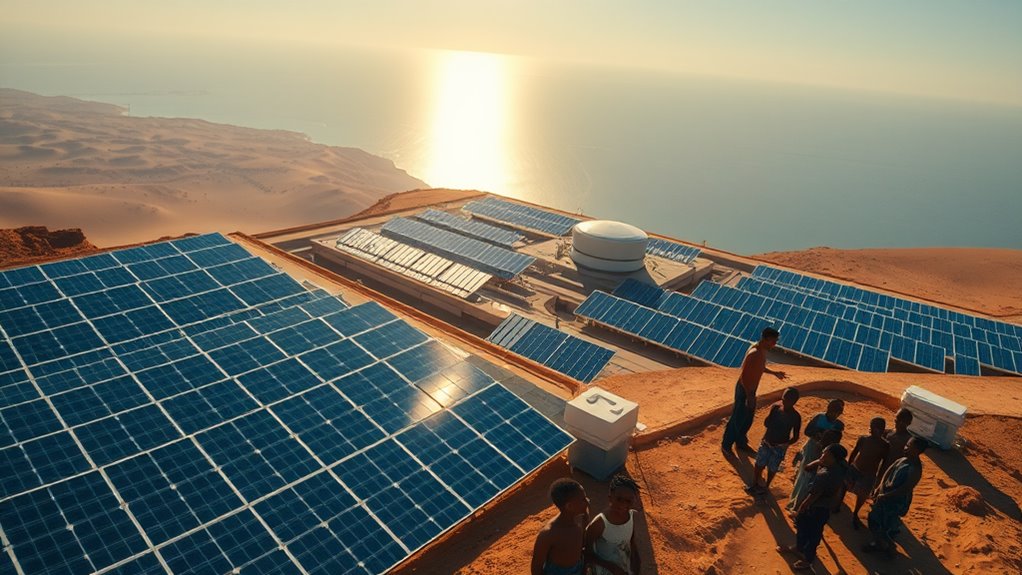
Technology is transforming solutions to the global water crisis through innovative methods. Advanced desalination techniques, such as solar-powered systems and zero-energy processes, are making seawater conversion more efficient. Smart irrigation systems utilize sensors and algorithms to optimize water use in agriculture, greatly reducing waste. Water purification technologies, including membrane filtration and UV disinfection, improve water safety. IoT and predictive analytics allow for real-time monitoring and better resource management, whereas blockchain promotes transparency in water usage. These initiatives reflect a growing trend in the direction of sustainable practices in water management, encouraging a deeper exploration of emerging technologies and community engagement.
The Global Water Crisis Overview
The global water crisis affects approximately two billion people worldwide, highlighting a pressing challenge that transcends borders and cultures. As the global population continues to surge, projected to reach nearly ten billion by 2050, the demand for freshwater resources intensifies, exacerbating the already critical issue of water scarcity. This scarcity is merely a matter of supply; it is intricately linked to economic stability, public health, and geopolitical tensions.
Countries with abundant water resources face the paradox of mismanagement, as arid regions grapple with the harsh realities of drought and limited access. The consequences of water scarcity extend beyond individual hardship; they threaten the very foundations of societal progress and security. Agriculture, a cornerstone of global food systems, is especially vulnerable, with approximately 70% of freshwater diverted for irrigation purposes. As climate change compounds these challenges, the urgency for sustainable water management becomes increasingly apparent.
Furthermore, the inequitable distribution of water resources often leads to social unrest and conflict, particularly in regions where competition for limited supplies is fierce. To navigate this complex terrain, stakeholders—including governments, corporations, and civil society—must prioritize innovative policies and practices that promote efficient water use and equitable access. Addressing the global water crisis requires not only technological advancements but also a concerted effort to reshape our approach to water governance, ensuring that this crucial resource is available for generations to come. The time for decisive action is now.
Innovative Desalination Techniques
Innovative desalination techniques are emerging as critical solutions to address the global water scarcity challenge. Among these, solar-powered desalination methods utilize renewable energy, alongside advanced membrane technologies offering improved efficiency and lower costs. Furthermore, zero-energy desalination solutions present a promising avenue for sustainable water production without reliance on traditional energy sources.
Solar-Powered Desalination Methods
Frequently, researchers are exploring solar-driven desalination methods as a sustainable solution to the growing global water crisis. These innovative techniques utilize solar energy to convert seawater into potable water, considerably reducing reliance on conventional energy sources. With the increasing emphasis on renewable technologies, solar desalination presents a formidable alternative, addressing both water scarcity and environmental sustainability.
Key advancements in solar efficiency have led to the development of various systems, including solar stills and solar-driven reverse osmosis units. These systems utilize advanced materials and designs to maximize energy capture and minimize energy loss, thereby enhancing overall output. In addition, the reduction in desalination costs, primarily driven by decreasing solar technology expenses, positions solar-driven desalination as an economically viable solution for arid regions and developing nations.
As countries grapple with escalating water demands, solar desalination emerges as an influential tool in the arsenal against water scarcity, promising not only to alleviate supply challenges but also to pave the way for sustainable development. The integration of solar energy into desalination processes will certainly play a critical role in shaping the future of water security globally, empowering communities with access to clean water.
Advanced Membrane Technologies
Advanced membrane technologies represent a significant leap forward in the field of desalination, offering improved efficiency and performance in the production of potable water from saline sources. Utilizing state-of-the-art membrane filtration techniques, these innovations utilize advanced materials that improve water permeability and selectivity, essential for tackling the escalating global water crisis.
| Technology Type | Benefits | Challenges |
|---|---|---|
| Reverse Osmosis | High efficiency | Membrane fouling |
| Nanofiltration | Selective ion removal | Limited scalability |
| Forward Osmosis | Low energy consumption | Requires further research |
The strategic deployment of these advanced membrane technologies not only optimizes the desalination process but also reduces operational costs and environmental impact. With a focus on sustainable practices, industries can now produce high-quality drinking water while minimizing energy expenditures. As the world grapples with increasing water scarcity, investing in these innovative solutions is not merely an option; it is a necessity for securing water resources and empowering communities globally. The future of water security lies in the mastery of advanced membrane technologies, positioning nations to capitalize on their potential for transformative impact.
Zero-Energy Desalination Solutions
A growing number of researchers are exploring zero-energy desalination solutions as a sustainable alternative to traditional desalination methods. This innovative approach utilizes natural energy sources, such as solar or wind energy, to minimize or eliminate the energy footprint typically associated with seawater treatment. By utilizing innovative materials, such as advanced membranes and hydrogels, these solutions can effectively separate salt from water during requiring minimal energy input.
One promising technique involves solar stills, which utilize the sun's heat to evaporate seawater, leaving salt behind, and then condensing the vapor to collect fresh water. Another approach is the use of pressure-retarded osmosis, which exploits the osmotic pressure difference between saltwater and freshwater to generate energy for desalination processes.
These zero-energy methods not only address the pressing need for freshwater in arid regions but also align with global sustainability goals. By utilizing sustainable energy and innovative materials, zero-energy desalination solutions present an influential opportunity to transform the way we think about water scarcity, paving the way for resilient and self-sufficient communities worldwide.
Smart Irrigation Systems
Smart irrigation systems represent a significant advancement in precision water usage, directly addressing the challenges of water scarcity. By incorporating soil moisture sensors, these systems optimize irrigation schedules based on real-time data, ensuring that crops receive the right amount of water at the right time. This technology not merely conserves water but additionally improves agricultural productivity and sustainability.
Precision Water Usage
In the pursuit of sustainable agriculture, precision water usage through innovative irrigation systems has emerged as a crucial solution. By leveraging advanced technologies, such as data analytics and automation, these systems optimize the delivery of water to crops, ensuring that every drop is utilized efficiently. This approach not only improves crop yields but also greatly reduces water waste, aligning with the pressing need for water efficient practices in an era marked by climate change and increasing demand for food.
Smart irrigation systems employ sophisticated algorithms to analyze environmental conditions and crop needs, enabling farmers to apply the right amount of water at precisely the right time. This targeted application minimizes runoff and evaporation losses, eventually conserving valuable water resources. Additionally, by adopting precision water usage, agricultural stakeholders can achieve better financial returns, as reduced water costs and improved crop productivity directly contribute to increased profitability.
In an increasingly resource-constrained world, embracing these advanced irrigation technologies is not merely an option; it is a strategic imperative for those seeking to exert influence in the agricultural sector. Sustainable agriculture through precision water usage is an influential catalyst for change, ensuring food security while safeguarding our planet's dwindling water resources.
Soil Moisture Sensors
The integration of soil moisture sensors into smart irrigation systems represents a significant advancement in precision agriculture. These state-of-the-art devices utilize sensor technology to provide real-time data on soil moisture levels, enabling farmers to make informed decisions that maximize water usage. By accurately measuring moisture content, these sensors facilitate soil moisture optimization, ensuring that crops receive the precise amount of water required for ideal growth without unnecessary waste.
As agricultural demands escalate amid global water shortages, the adoption of soil moisture sensors is not merely a trend; it is a strategic imperative. These systems reduce reliance on traditional irrigation methods, which often lead to overwatering and resource depletion. By employing intelligent algorithms that analyze sensor data, smart irrigation systems can automate watering schedules, efficiently distributing water to where it is most needed.
The implications of this technology extend beyond mere efficiency. By utilizing soil moisture data, farmers can improve crop yields, reduce operational costs, and contribute to sustainable water management practices. In a world where water scarcity poses a formidable challenge, the deployment of soil moisture sensors marks a transformative shift in the direction of a more resilient agricultural future.
Water Purification Technologies
Advancing water purification technologies is crucial for addressing the global water crisis and guaranteeing access to safe drinking water. The integration of state-of-the-art methods such as membrane filtration and UV disinfection presents strong solutions to combat waterborne contaminants and support public health.
Membrane filtration employs semi-permeable barriers to effectively separate impurities from water, delivering purified output that meets stringent safety standards. This technology is particularly advantageous in removing pathogens, heavy metals, and suspended solids. Its versatility allows for customized applications across various sectors, including municipal water systems, industrial processes, and even decentralized systems for remote communities.
Meanwhile, UV disinfection utilizes the germicidal properties of ultraviolet light to inactivate microorganisms, rendering them incapable of reproduction. This method stands out for its efficacy, speed, and lack of harmful byproducts, making it an attractive choice for both large-scale treatment facilities and household systems. Significantly, UV disinfection complements membrane filtration, providing a multi-barrier approach that greatly improves overall water safety.
Together, these innovative purification technologies are not merely improvements; they represent a paradigm shift in how we approach water management. By investing in and adopting advanced purification systems, we can guarantee that every individual has access to clean, safe drinking water, thereby empowering communities and promoting economic growth. The future hinges on our commitment to these transformative technologies, which promise to redefine global water security and sustainability.
Rainwater Harvesting Solutions
Rainwater harvesting solutions offer a sustainable approach to addressing water scarcity by capturing and utilizing precipitation for various needs. As urban populations expand and climate change intensifies, the necessity for innovative water management strategies has never been more pressing. Implementing rainwater harvesting systems empowers individuals and communities to take charge of their water resources, reducing reliance on municipal supplies and increasing resilience against droughts.
Key benefits of rainwater harvesting include:
- Cost Efficiency: Reduced water bills through the use of free, naturally occurring precipitation.
- Environmental Impact: Decreased runoff and erosion, contributing to healthier ecosystems.
- Versatility: Suitable for diverse applications, from irrigation to domestic water supply.
Rooftop systems are particularly effective, capturing rainwater directly from building surfaces. These systems can be integrated with advanced rainwater filtration technologies, ensuring that the collected water meets safety standards for various uses. By utilizing state-of-the-art filtration methods, contaminants are effectively removed, making rainwater a viable alternative for non-potable applications, such as irrigation and toilet flushing.
The implementation of rainwater harvesting not merely serves immediate water needs but likewise promotes a proactive approach to resource management. As communities increasingly adopt this technology, they improve their autonomy in the face of global water challenges. In this dynamic environment, rainwater harvesting stands as a beacon of innovation, encouraging a shift toward self-sufficiency and sustainable water use, thereby empowering individuals and enterprises alike to reclaim control over their water destiny.
Wastewater Recycling Advances
Innovations in wastewater recycling are emerging as a crucial complement to rainwater harvesting solutions in the quest for sustainable water management. As global water scarcity intensifies, the need for advanced wastewater treatment methods has never been more critical. These technologies not merely address the immediate challenge of water shortages but also transform wastewater into a valuable resource, nurturing a paradigm shift in how we perceive and utilize water.
Cutting-edge wastewater recycling systems employ sophisticated biological and chemical processes to purify used water, making it suitable for a variety of applications, including irrigation, industrial use, and even potable purposes. These systems prioritize resource recovery, maximizing the extraction of valuable byproducts such as nutrients, energy, and reclaimed water. This holistic approach guarantees that water is not merely treated and discarded; instead, it is reintegrated into the ecosystem as a functional resource, thereby promoting circular water economies.
Emerging technologies, such as membrane bioreactors and advanced oxidation processes, are enhancing the efficiency and effectiveness of wastewater treatment, considerably reducing contaminants and pathogens. The integration of these technologies positions municipalities and industries to not only meet regulatory standards but also to lead in sustainable practices that resonate with environmentally conscious stakeholders.
IoT in Water Management
Utilizing the strength of the Internet of Things (IoT) in water management is revolutionizing how we monitor, distribute, and conserve this crucial resource. With the integration of advanced technologies, water management systems are becoming smarter, more efficient, and highly responsive to real-time conditions. The deployment of smart sensors throughout the infrastructure allows for thorough data collection, leading to improved decision-making processes.
Key benefits of IoT in water management include:
- Real-time monitoring: Continuous data flow from smart sensors provides immediate insights into water quality and availability.
- Predictive analytics: Using algorithms, water utilities can forecast demand, prevent leaks, and optimize resource allocation, thereby reducing waste.
- Automated control systems: Improved automation allows for swift adjustments to distribution networks based on fluctuating conditions and consumption patterns.
The influence of predictive analytics utilizes historical data to anticipate future water needs, enabling municipalities and organizations to manage resources proactively. This capability not only conserves water but also greatly reduces operational costs. Additionally, integrating IoT technology promotes transparency, allowing stakeholders to engage in sustainable practices and hold water providers accountable.
As we confront escalating water scarcity challenges, leveraging IoT in water management stands at the forefront of innovative solutions. By embracing these advancements, we can secure a more resilient and sustainable future for our most crucial resource. The intersection of smart sensors and predictive analytics paves the way for a transformative era in water management, empowering us to tackle the pressing water crisis with confidence.
Solar-Powered Water Solutions
Utilizing solar energy to address water scarcity presents a promising avenue for sustainable solutions. As the global demand for clean water intensifies, innovative approaches leveraging the energy of the sun emerge as essential components in the quest for water sustainability. Solar-powered water solutions not only mitigate reliance on conventional energy sources but additionally provide a means to purify and distribute water in resource-constrained regions.
Solar desalination systems exemplify the transformative potential of this technology. By utilizing solar energy to evaporate seawater, these systems generate fresh water with minimal environmental impact. This method is particularly advantageous in arid coastal regions, where traditional freshwater sources are scarce. Moreover, photovoltaic (PV) systems can be deployed to power water pumping stations, enabling the efficient distribution of water from wells or surface sources to communities in need.
In addition to addressing immediate water scarcity challenges, solar-powered solutions contribute to long-term sustainability goals. By integrating solar energy into water management practices, communities can reduce greenhouse gas emissions and promote resilience against climate change. This dual benefit raises the significance of solar energy as a cornerstone in the global strategy for achieving water sustainability.
The adoption of solar-powered water solutions represents a critical shift in empowering communities with autonomy over their water resources. Through continued investment and innovation in this sector, we can unlock the full capacity of solar energy, paving the way for a future where clean, accessible water is a universal right.
AI for Water Conservation
As the integration of solar energy continues to improve water sustainability efforts, artificial intelligence (AI) emerges as a potent tool for water conservation. The convergence of advanced AI technologies and renewable energy sources is reshaping how we manage water resources. By utilizing machine learning applications and predictive analytics tools, stakeholders can make data-driven decisions that optimize water usage and reduce waste.
Key benefits of AI in water conservation include:
- Enhanced Predictive Maintenance: Utilizing AI algorithms to foresee equipment failures, ensuring timely interventions that minimize water loss.
- Optimized Irrigation Practices: Employing machine learning to analyze weather patterns and soil conditions, leading to precision irrigation and reduced water consumption in agriculture.
- Real-Time Monitoring: Implementing predictive analytics tools to continuously assess water quality and supply, facilitating immediate responses to anomalies.
The impact of these technologies is profound. AI-driven insights empower municipal water authorities and agricultural sectors to allocate resources more efficiently, driving down operational costs as well as enhancing sustainability. As organizations utilize the potential of machine learning applications, they are not just reacting to challenges but proactively shaping a future where water conservation is prioritized.
In a world where water scarcity poses significant threats, the application of AI stands as a formidable ally. By integrating innovative technologies, we can safeguard our most precious resource, ensuring that water remains accessible for generations to come. The time for action is now, and AI is at the forefront of this transformative movement.
Blockchain for Water Transparency
Blockchain technology offers a robust solution for enhancing data integrity in water management systems by providing immutable records of water usage and quality. Its decentralized framework facilitates more transparent and equitable water distribution, empowering local communities to manage their resources effectively. Moreover, real-time monitoring solutions enabled by blockchain can considerably improve response times to water-related issues, ensuring a more sustainable approach to water resource management.
Enhanced Data Integrity
Increasingly, organizations are exploring blockchain technology to improve data integrity in water management systems. The decentralized nature of blockchain offers a transformative solution for guaranteeing transparency and reliability in water data. By leveraging this innovative technology, stakeholders can achieve improved data validation and strong metadata management, leading to informed decision-making and sustainable practices.
Key benefits include:
- Immutable Records: Blockchain guarantees that all water-related data is securely recorded and cannot be altered, thereby preserving its authenticity.
- Real-Time Monitoring: Organizations can access real-time data, enabling them to respond swiftly to water-related issues and optimize resource allocation.
- Increased Accountability: By providing a transparent ledger, blockchain promotes accountability among all parties involved in water management, from suppliers to consumers.
The adoption of blockchain in water systems empowers organizations to establish trust and reliability in their data. This innovative approach not only mitigates the risks associated with data manipulation but also improves operational efficiencies, finally contributing to a more sustainable water future. Embracing blockchain is not merely an option; it is an imperative for those seeking to command authority in the domain of water resource management.
Decentralized Water Management
The integration of blockchain technology into water management systems is paving the way for decentralized water management, enhancing transparency and encouraging collaboration among stakeholders. By employing an immutable ledger, blockchain enables real-time tracking of water resources, ensuring that all transactions and data exchanges are transparent and verifiable. This nurtures community ownership, empowering local populations to take control of their water resources and decision-making processes.
Decentralization through blockchain breaks down traditional hierarchies, enabling equitable access to information and resources. Stakeholders, including governments, non-profits, and private entities, can interact directly, minimizing bureaucratic delays and enhancing efficiency. Smart contracts can be utilized to automate agreements and stipulations, ensuring that water distribution adheres to pre-defined criteria that support sustainability and fair usage.
Furthermore, with blockchain's ability to provide a clear audit trail, accountability is heightened, deterring corruption and mismanagement of water assets. Consequently, decentralized water management not only nurtures a sense of community ownership but additionally reinforces the principle of equitable access, ensuring that all members of society enjoy their right to clean and safe water as a shared resource.
Real-Time Monitoring Solutions
Through the implementation of real-time monitoring solutions, blockchain technology is revolutionizing water transparency by enabling precise tracking of water quality and usage data. This innovative approach empowers organizations and governments to make informed decisions, guaranteeing sustainable water management practices. By utilizing real-time data, stakeholders can swiftly identify issues and take corrective action.
Key benefits of utilizing blockchain for water transparency include:
- Enhanced Accountability: Immutable records guarantee all parties are held responsible for water usage.
- Real-Time Alerts: Immediate notifications of quality fluctuations or leaks enable rapid response.
- Data Accessibility: Stakeholders can access thorough monitoring tools, promoting collaboration and transparency.
The integration of blockchain into water monitoring systems is not merely a technological advancement; it is a strategic necessity. As global water scarcity intensifies, the ability to leverage real-time data for effective governance becomes paramount. By embracing these monitoring tools, decision-makers can champion a future where water resources are managed with unparalleled precision and integrity, ultimately protecting this crucial resource for generations to come.
Community-Based Water Initiatives
How can local communities effectively tackle the challenges of water scarcity? The answer lies in the strength of community-based water initiatives, which utilize local knowledge and encourage collaboration among stakeholders. By prioritizing community engagement, these initiatives enable individuals to take ownership of their water resources, ensuring sustainable management that aligns with their specific needs and circumstances.
Local partnerships are fundamental to the success of these initiatives. When municipalities, non-profit organizations, and local businesses come together around a shared vision for water management, they amplify their resources and influence. This synergy improves the implementation of innovative solutions customized to the unique challenges faced by each community, from drought resistance to efficient water distribution.
Moreover, community-based initiatives often incorporate technology to improve water quality and accessibility. For instance, mobile apps can facilitate real-time communication among community members, enabling them to report water quality issues or share conservation tips. These tools not only promote transparency but also cultivate a culture of accountability and proactive stewardship.
As communities mobilize to address water scarcity, they create a resilient framework that adapts to changing environmental conditions. By utilizing the collective strength of local partnerships and community engagement, these initiatives serve as a blueprint for sustainable water management. In an era marked by increasing water challenges, the significance of empowering local communities cannot be overstated; they are not merely beneficiaries but critical stakeholders in the global endeavor to secure our most crucial resource.
Future Trends in Water Technology
Innovations in water technology are set to reshape the terrain of water management, addressing the urgent challenges posed by scarcity and contamination. As the global demand for water continues to outpace supply, forward-thinking enterprises are utilizing state-of-the-art solutions to guarantee sustainability and equity in water distribution. The future of water technology is characterized by strategic technology collaboration that empowers stakeholders across multiple sectors to combat water scarcity effectively.
Key trends shaping this future include:
- Smart Water Systems: Leveraging IoT and AI to optimize water usage and detect leaks in real-time, improving efficiency and minimizing waste.
- Desalination Advances: Innovations in energy-efficient desalination processes will make ocean water a viable source for drinking, particularly in arid regions.
- Water Recycling Technologies: Improved methods for treating wastewater are paving the way for a circular economy, where water is reused rather than discarded.
These advancements underscore a critical pivot in how societies approach water management. By integrating technology and cultivating collaboration among governments, private sectors, and NGOs, we can forge resilient infrastructures that both alleviate the impacts of water scarcity and promote equitable access to clean water. As we stand on the brink of a technological revolution in water management, the imperative to act decisively has never been clearer. The time to adopt these transformative solutions is now, securing a sustainable water future for generations to come.
Frequently Asked Questions
How Can Individuals Contribute to Solving the Water Crisis?
Approximately 2.2 billion people globally lack access to safe drinking water, underscoring the urgency of addressing this crisis. Individuals can greatly contribute through personal actions, such as reducing water waste and adopting sustainable practices. Furthermore, engaging in community initiatives nurtures collective responsibility, amplifying efforts to conserve this essential resource. By prioritizing water stewardship, individuals not only improve their local environments but additionally empower broader societal change, demonstrating the profound impact of grassroots involvement.
What Role Do Governments Play in Water Technology Advancements?
Governments play a pivotal role in advancing water technology through the establishment of robust policy frameworks and the provision of government incentives. By facilitating research and development, they encourage innovation in water management solutions. Furthermore, effective policies can attract private investment, ensuring sustainable funding for technological advancements. Governments must prioritize collaboration with stakeholders to create an ecosystem that nurtures growth and addresses pressing water challenges, eventually enhancing resilience and sustainability in water resource management.
Are There Risks Associated With New Water Technologies?
The introduction of new water technologies is not without its risks. Safety concerns may arise from inadequate testing or unforeseen interactions with existing systems, potentially jeopardizing public health. Moreover, technology reliability remains a critical issue; failures in these systems can lead to severe consequences. As stakeholders pursue innovative solutions, it is imperative to prioritize rigorous assessments and regulatory frameworks to guarantee that advancements in water technology do not compromise safety or dependability.
How Can Education Improve Water Conservation Efforts?
Education plays a pivotal role in enhancing water conservation efforts by equipping individuals and communities with knowledge about effective water saving techniques. Through conservation education, stakeholders can cultivate awareness of sustainable practices, influencing behavioral change and promoting responsible water use. By integrating thorough educational programs into community initiatives, we can empower citizens to make informed decisions, eventually leading to a collective reduction in water waste and a more sustainable future for water resources.
What Are the Economic Impacts of Water Scarcity?
Water scarcity considerably impacts global economies, with estimates suggesting that by 2030, water demand could exceed supply by 40%. This imbalance drives water pricing to new heights, forcing industries to adopt innovative investment strategies to mitigate risks associated with resource shortages. As water becomes increasingly scarce, businesses must prioritize sustainable practices to guarantee long-term viability, whereas policymakers must implement frameworks that promote equitable water access and encourage investments in efficient water management systems.
