
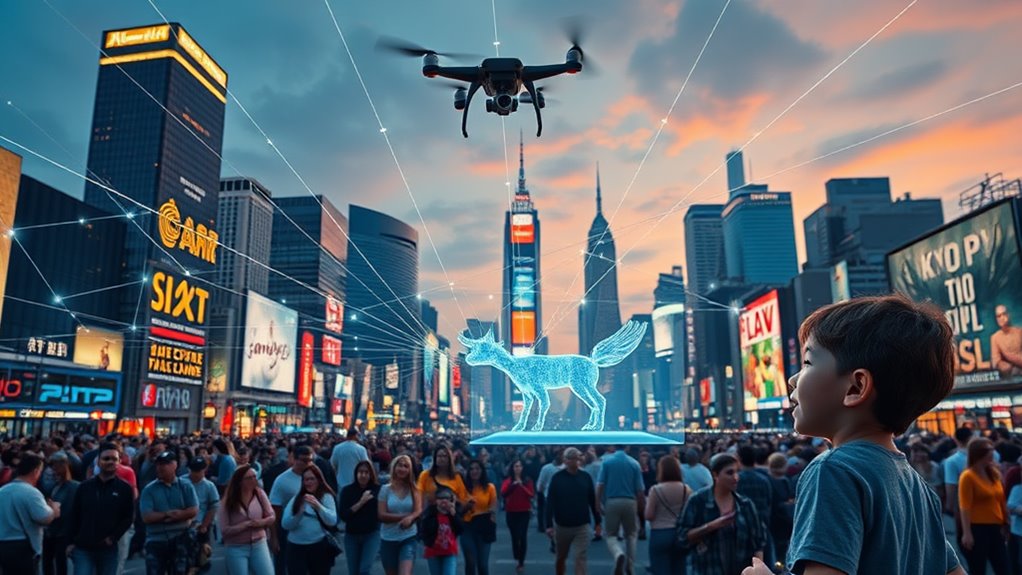
5G is transforming global connectivity through significant advancements in speed, capacity, and latency. Offering download speeds exceeding 10 Gbps and ultra-low latency as low as 1 millisecond, it facilitates real-time communications and supports up to one million devices per square kilometer. This technology bolsters IoT applications, smart cities, and autonomous vehicles, optimizing urban environments and enhancing transportation safety. Furthermore, 5G changes healthcare with real-time patient monitoring and effective virtual consultations. As economies adapt and security measures evolve, the broader implications of 5G continue to unfold, presenting opportunities worth exploring in further detail.
Overview of 5G Technology
5G technology represents a notable leap in wireless communication, characterized by improved speed, reduced latency, and increased capacity compared to its predecessors. This groundbreaking advancement in network architecture improves the ability to connect a myriad of devices simultaneously, paving the way for the Internet of Things (IoT) and smart city initiatives. The deployment of 5G is not merely an upgrade; it is a foundational transformation that enables industries to operate with unprecedented efficiency and interoperability.
At the core of 5G lies a sophisticated network architecture designed to prioritize user experience and resource optimization. By utilizing a combination of millimeter waves, small cells, and massive MIMO (multiple input, multiple output) technology, 5G networks can handle a considerably greater amount of data traffic with minimal interference. This architectural sophistication guarantees that businesses and consumers alike can utilize high-performance connectivity to drive innovation and growth.
As 5G technology undergoes global deployment, it is reshaping the environment of connectivity on an international scale. Countries around the world are racing to implement this technology, recognizing its potential to transform industries such as healthcare, transportation, and entertainment. The implications of widespread 5G adoption extend beyond mere convenience; they promise to redefine economic competitiveness and societal progress. In a world increasingly reliant on seamless communication, 5G stands as a beacon of technological prowess, empowering nations and corporations to tap into the full potential of a hyper-connected future.
Speed and Performance Enhancements
Transforming connectivity, 5G technology delivers remarkable speed and performance improvements that greatly exceed those of previous generations. The advent of 5G heralds a new era, where users can experience download speeds exceeding 10 Gbps, compared to the maximum speeds of around 1 Gbps offered by 4G networks. This dramatic improvement is not merely a quantitative leap; it translates into substantial qualitative benefits in user experience and operational efficiency.
A key factor contributing to this evolution is latency reduction. 5G networks promise latency as low as 1 millisecond, facilitating real-time communication and enabling applications that were previously deemed impractical. Industries reliant on instantaneous data transfer, such as telemedicine and autonomous vehicles, stand to gain immensely from this reduction in response time.
Furthermore, bandwidth expansion is a cornerstone of 5G's transformative capabilities. With the ability to support a considerably greater number of devices simultaneously, 5G eliminates the congestion that often plagues urban environments and densely populated areas. This increased capacity not only improves mobile broadband services but also empowers the Internet of Things (IoT), allowing countless devices to communicate seamlessly.
Impact on Smart Cities
The evolution of connectivity through advanced technologies ushers in a profound impact on the development and functioning of smart cities. The advent of 5G technology serves as a catalyst for transforming urban environments into interconnected ecosystems where smart infrastructure thrives. By facilitating real-time data exchange and improving communication between devices, 5G empowers city planners and decision-makers to optimize urban planning processes with unprecedented efficiency.
Smart cities leverage 5G to implement intelligent transportation systems, improve energy management, and enhance public safety measures. The integration of advanced sensors and IoT devices enables municipalities to monitor traffic patterns, manage energy consumption, and respond to emergencies instantaneously. This level of interconnectivity not only improves the quality of life for residents but also positions cities as hubs of innovation and economic growth.
Moreover, the capability of 5G to support massive device connectivity allows for the deployment of smart infrastructure at scale. As cities increasingly adopt smart grids and automated waste management systems, the potential for improved resource allocation and sustainability becomes clearer. Urban planning is therefore raised to a strategic endeavor, as real-time analytics inform decisions that shape the future of our cities.
In essence, the impact of 5G on smart cities is transformative, driving a paradigm shift towards more sustainable, efficient, and resilient urban environments. By utilizing this technology, city leaders can forge a robust framework for progress, ensuring that their jurisdictions remain competitive in an increasingly connected world.
Advancements in Telemedicine
The advent of 5G technology is revolutionizing telemedicine by enabling remote patient monitoring, which allows healthcare providers to track patient health metrics in real-time. Improved virtual consultations are becoming more effective, facilitating seamless interactions between patients and doctors regardless of location. Moreover, the capability for real-time data sharing boosts decision-making and improves patient outcomes, marking a significant advancement in healthcare delivery.
Remote Patient Monitoring
Advancements in telemedicine are revolutionizing the way healthcare providers monitor patients remotely, improving both accessibility and efficiency. Central to this transformation is the integration of 5G technology, which enables real-time data transmission and strong connectivity. As a result, healthcare professionals can engage patients in their health management like never before, nurturing an environment of proactive patient engagement.
Remote patient monitoring systems leverage advanced health analytics to collect and analyze patient data from wearable devices and home monitoring equipment. This empowers clinicians to make data-driven decisions, tailoring treatments to individual needs as they minimize the necessity for in-person visits. The immediacy of information allows for timely interventions, reducing hospital readmissions and improving overall patient outcomes.
Furthermore, 5G's low latency and high bandwidth capabilities facilitate seamless communication between patients and providers, ensuring that critical health information is always at their fingertips. This not only improves patient experience but drives operational efficiencies within healthcare systems. As organizations utilize the potential of remote patient monitoring, they position themselves at the forefront of a healthcare revolution that prioritizes accessibility, efficiency, and patient empowerment.
Enhanced Virtual Consultations
Healthcare providers' ability to conduct improved virtual consultations has been greatly strengthened by the implementation of 5G technology. This advancement enables healthcare professionals to deliver exceptional virtual health services, transcending geographical limitations and improving patient engagement. With markedly reduced latency and increased bandwidth, 5G allows real-time interactions that are fundamental for effective remote diagnosis.
The integration of high-definition video conferencing tools facilitates more accurate assessments, allowing physicians to observe subtle physical cues that are vital for diagnosis. Patients, empowered by the convenience of virtual consultations, can access specialized care without the constraints of travel and time. This shift not only optimizes resource allocation within healthcare systems but additionally boosts patient satisfaction by providing timely interventions.
Moreover, the robust infrastructure of 5G supports the seamless exchange of diagnostic data and imaging, ensuring that healthcare professionals have immediate access to essential information during consultations. As healthcare continues to evolve, the role of enhanced virtual consultations will be critical in establishing a proactive approach to patient care, eventually leading to improved health outcomes and a more resilient healthcare ecosystem. The transformative influence of 5G in telemedicine is not merely advantageous; it is indispensable for the future of healthcare delivery.
Real-Time Data Sharing
In the domain of telemedicine, real-time data sharing stands as a cornerstone for enhancing patient care and clinical decision-making. The advent of 5G technology empowers healthcare providers to utilize robust data synchronization and real-time analytics, facilitating seamless communication and immediate access to crucial patient information.
The benefits of real-time data sharing in telemedicine are profound:
- Enhanced Patient Monitoring: Continuous tracking of essential signs and health metrics allows for proactive interventions.
- Improved Diagnostic Accuracy: Instantaneous access to medical histories and imaging results diminishes the margin for error.
- Streamlined Clinical Collaboration: Healthcare teams can engage in efficient consultations, ensuring cohesive care strategies.
- Informed Decision-Making: Real-time analytics provide actionable insights, enabling clinicians to make informed decisions swiftly.
As healthcare ecosystems evolve, the integration of real-time data sharing catalyzes a transformation in patient management and outcomes. With the ability to utilize instantaneous data, healthcare providers are positioned to deliver superior care, reinforcing the significance of 5G connectivity in modern medicine. The future of telemedicine is not just about communication; it's about empowering healthcare professionals with the tools they need to excel.
Revolutionizing Autonomous Vehicles
How will 5G technology redefine the environment of autonomous vehicles? The integration of 5G connectivity is set to transform the functionality, safety features, and efficiency of autonomous driving systems. With ultra-reliable low-latency communication, vehicles will be able to exchange real-time information with infrastructure, other vehicles, and cloud services, thereby improving traffic management and safety protocols.
The following table illustrates the key improvements that 5G brings to autonomous vehicles:
| Aspect | Impact of 5G |
|---|---|
| Safety Features | Enhanced collision avoidance systems through faster data exchange. |
| Traffic Management | Optimized routing based on real-time traffic conditions, reducing congestion. |
| Vehicle-to-Everything (V2X) | Seamless communication with traffic signals and other road users. |
| Predictive Analytics | Improved predictive algorithms based on aggregated data, ensuring safer navigation. |
| Remote Monitoring | Continuous vehicle health diagnostics, enabling proactive maintenance. |
In an era where safety and efficiency are paramount, 5G's capability to support high-density data transmission will enable autonomous vehicles to make instantaneous decisions based on thorough situational awareness. As a result, this unprecedented level of connectivity will not only improve the driving experience but also establish a more reliable and efficient transportation ecosystem. As we utilize the strength of 5G, the autonomous vehicle environment will evolve, promoting a future where safety and intelligent traffic management are seamlessly intertwined.
Enhancing IoT Connectivity
The advancements in 5G technology extend beyond autonomous vehicles, substantially improving the Internet of Things (IoT) connectivity environment. With its remarkable speed and low latency, 5G enables a vast array of devices to communicate seamlessly, leading to unprecedented levels of device interoperability. This evolution signifies a paradigm shift in how organizations utilize IoT applications to optimize operational efficiency and improve decision-making processes.
Key benefits of improved IoT connectivity through 5G include:
- Increased Device Density: 5G networks can support up to one million devices per square kilometer, facilitating expansive IoT ecosystems.
- Real-time Data Processing: The rapid data transfer capabilities of 5G enable real-time analytics, allowing organizations to respond to changes instantaneously.
- Improved IoT Security: 5G introduces advanced security protocols, addressing vulnerabilities and ensuring the integrity of data transmitted across networks.
- Scalability: Organizations can effortlessly scale their IoT deployments, accommodating growth without compromising performance.
In a world where data is the new currency, the integration of robust IoT solutions through 5G technology offers organizations the ability to leverage insights that drive innovation and competitive advantage. Additionally, improved IoT security measures not only protect sensitive information but also build trust among stakeholders. As 5G continues to proliferate, its transformative impact on IoT connectivity will set the stage for a new era of intelligent automation and interconnected systems, positioning enterprises for sustained success in the digital age.
Economic Impacts of 5G
Transformative economic impacts are anticipated as 5G technology continues to roll out globally. This next-generation connectivity is poised to catalyze job creation across diverse sectors, from telecommunications to manufacturing, thereby fortifying workforce resilience and improving overall economic growth. As businesses leverage 5G to optimize operations, there will be an unprecedented surge in infrastructure investment, essential for supporting advanced applications and services.
By bridging the digital divide, 5G empowers underserved communities with access to high-speed internet, enabling equitable participation in the digital economy. This inclusivity not only encourages social equity but also stimulates local economies, contributing to a more dynamic and sustainable economic environment. Furthermore, nations embracing 5G will greatly enhance their global competitiveness, positioning themselves as leaders in the digital transformation race.
The innovation acceleration driven by 5G technology is another vital aspect of its economic impact. Improved connectivity will facilitate the rapid development of smart cities, autonomous vehicles, and advanced healthcare solutions, revealing new revenue streams and boosting productivity. As industries adopt 5G-enabled technologies, they will experience heightened efficiency and reduced operational costs, further driving economic growth.
Future Trends in Connectivity
Anticipating the future of connectivity reveals a territory shaped by rapid advancements in technology and evolving user demands. As we shift into an era dominated by 5G and beyond, the environment of future networks is poised for transformative changes that promise to address existing connectivity challenges while introducing new opportunities for innovation and growth.
The interplay of artificial intelligence, Internet of Things (IoT), and edge computing will drive the next wave of connectivity. Businesses and consumers alike will benefit from improved network reliability, lower latency, and the capacity to support a growing number of connected devices. Key trends to watch include:
- Integration of AI: Utilizing artificial intelligence for network optimization and predictive maintenance, guaranteeing seamless connectivity.
- Expansion of IoT: The proliferation of smart devices will necessitate robust networks capable of handling massive data streams.
- Cloud-Native Architectures: Future networks will increasingly rely on cloud-native technologies, improving flexibility and scalability for service providers.
- Sustainability Measures: As environmental concerns rise, networks will evolve to prioritize energy efficiency and reduced carbon footprints.
However, maneuvering through these advancements will not be without challenges. Connectivity challenges such as security vulnerabilities, infrastructure disparities, and regulatory hurdles must be addressed to guarantee equitable access to future networks. As stakeholders collaborate to overcome these obstacles, the potential for unprecedented advancements in connectivity will emerge, reshaping our digital environment and empowering users worldwide. Therefore, the future of connectivity lies not solely in technological prowess but also in strategic foresight and collaborative efforts.
Frequently Asked Questions
What Are the Health Effects of 5G Technology on Humans?
The health effects of 5G technology on humans remain a topic of debate and ongoing research. Current health studies indicate that 5G exposure, like previous generations of mobile technology, falls within established safety limits set by international organizations. Nonetheless, some researchers advocate for further investigation into long-term exposure effects, emphasizing the need for vigilance. As technology advances, it is imperative to balance innovation with thorough health assessments to guarantee public safety and well-being.
How Does 5G Affect Rural Connectivity Compared to Urban Areas?
In the vast digital terrain, where urban dominance reigns, 5G emerges as a beacon of hope for rural expansion. This technology has the potential to bridge the connectivity chasm, empowering rural areas with unprecedented internet speeds and reliability. By dismantling the barriers imposed by geography, 5G encourages economic growth and innovation, ensuring that even the most remote communities can participate in the global digital economy, thereby leveling the playing field between urban and rural environments.
What Are the Security Concerns Associated With 5G Networks?
The security concerns associated with 5G networks encompass significant issues such as data privacy and network vulnerabilities. As 5G technology enables faster data transmission and connects a multitude of devices, the potential for cyberattacks escalates. Malicious entities may exploit these vulnerabilities to access sensitive information, undermining user trust and compromising critical infrastructure. Consequently, it is imperative for stakeholders to prioritize robust security measures to safeguard data integrity and maintain operational resilience in an interconnected environment. To address these challenges, organizations are increasingly exploring advanced solutions such as blockchain and digital security to enhance data protection and prevent unauthorized access. By leveraging decentralized encryption and automated threat detection, these technologies can help mitigate risks associated with cyber threats. Implementing such measures will be crucial in ensuring the reliability and trustworthiness of 5G networks in the future.
How Does 5G Impact Energy Consumption in Technology?
The impact of 5G on energy consumption in technology is significant, primarily through improved energy efficiency and network optimization. 5G networks utilize advanced technologies such as beamforming and network slicing, which streamline data transmission and reduce energy requirements. As a result, this leads to lower operational costs for service providers during minimizing the environmental footprint. As industries increasingly adopt 5G, the potential for sustainable energy practices in technology becomes a critical focus for future developments.
What Devices Are Compatible With 5G Connectivity?
In the grand symphony of connectivity, 5G serves as the maestro, conducting a harmonious blend of devices. The ensemble includes 5G smartphones, equipped to navigate the fast currents of data with unparalleled agility. Complementing this are 5G routers, which act as the strong foundation, amplifying signals across vast terrains. Together, they create a potent ecosystem, enabling users to utilize the full potential of next-generation technology, charting a path toward unprecedented digital experiences.
