
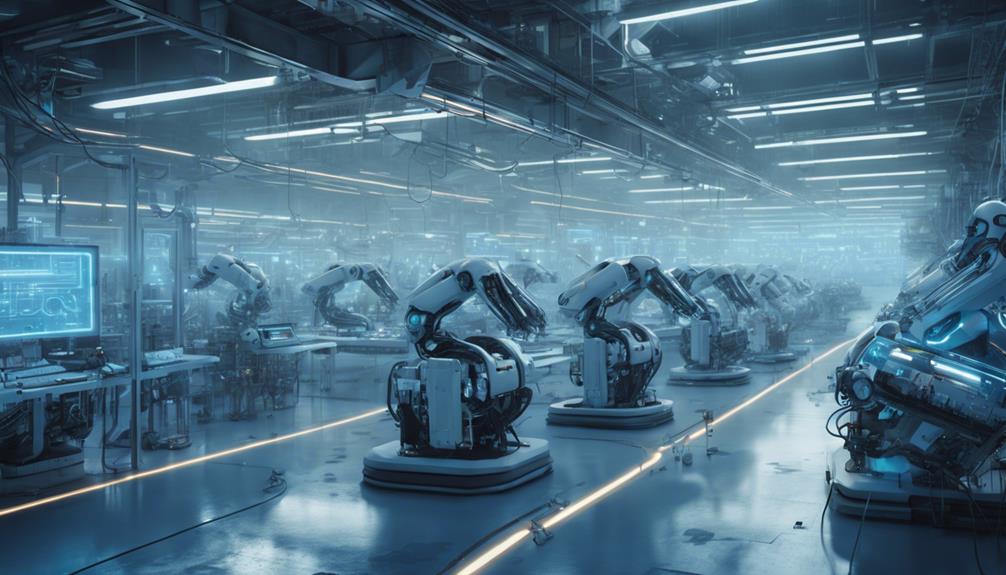
Across modern industries, artificial intelligence has emerged as a transformative force, driving efficiency, improving outcomes, and revolutionizing traditional workflows. AI optimizes production, streamlines logistics, and enhances decision-making, freeing up resources for high-value tasks. It detects equipment failures, identifies inefficiencies, and aids in medical imaging analysis. AI-driven predictive maintenance and business decision-making capabilities have a direct impact on a company's bottom line. As AI continues to advance, its applications are becoming increasingly diverse, and its potential to transform industries is vast – and there's still much to explore in the world of AI-driven innovation.
AI in Manufacturing and Production
Manufacturers are leveraging artificial intelligence to optimize production workflows, streamline supply chains, and improve product quality. This integration has transformed the manufacturing landscape, enabling companies to produce high-quality products efficiently and effectively. One significant area where AI has made a substantial impact is in quality control. By deploying AI-powered sensors and cameras, manufacturers can detect even the slightest defects or anomalies in products, allowing them to take prompt corrective action. This real-time quality control guarantees that only perfect products reach the market, reducing waste and increasing customer satisfaction.
Another area where AI is revolutionizing manufacturing is material optimization. By analyzing vast amounts of data on material usage, AI algorithms can identify areas of inefficiency and suggest the most effective material quantities, reducing waste and saving costs. This not only benefits the manufacturer but also reduces the environmental impact of production. Additionally, AI can help optimize material selection, ensuring that the best materials are used for each product, further enhancing quality and reducing defects. As AI continues to evolve, manufacturers can expect even more innovative applications, such as predictive maintenance and demand forecasting. By embracing AI, manufacturers can stay ahead of the competition, improve productivity, and deliver exceptional products that meet customer expectations.
Streamlining Logistics and Supply Chain
AI is now being applied to streamline logistics and supply chain operations, enabling companies to navigate complex networks, anticipate bottlenecks, and make data-driven decisions that reduce costs and enhance customer experience. By leveraging machine learning algorithms and real-time data, AI-powered systems can optimize routes for delivery trucks, reducing fuel consumption and lowering emissions. This route optimization not only saves companies money but also helps them meet growing customer demands for faster and more sustainable delivery options.
AI is also being used to improve inventory forecasting, enabling companies to better anticipate demand and adjust their stock levels accordingly. By analyzing historical sales data, seasonality, and external factors like weather and economic trends, AI-powered systems can predict future demand with uncanny accuracy. This allows companies to avoid stockouts and overstocking, reducing waste and minimizing the need for costly last-minute shipments.
Moreover, AI-driven analytics can help companies identify inefficiencies in their supply chain, such as bottlenecks in production or transportation. By pinpointing these issues, companies can take targeted actions to address them, leading to improved overall efficiency and reduced costs. As the logistics and supply chain landscape continues to evolve, AI is poised to play an increasingly important role in helping companies stay competitive and meet the demands of an increasingly complex and interconnected world.
AI-Powered Predictive Maintenance
By leveraging real-time sensor data and machine learning algorithms, companies can now detect potential equipment failures before they occur, reducing downtime and increasing overall productivity. This AI-powered predictive maintenance enables businesses to schedule maintenance during planned downtime, minimizing the impact on operations. With the ability to predict equipment failures, companies can also reduce repair costs and extend the lifespan of their equipment.
The accuracy of predictive maintenance relies heavily on the quality of the data used to train the machine learning models. Companies must make certain that their sensor data is accurate, complete, and reliable to generate reliable predictions. Additionally, the algorithms used must be sophisticated enough to detect subtle patterns and anomalies in the data.
Implementing AI-powered predictive maintenance can have a significant impact on a company's bottom line. By reducing downtime and increasing productivity, businesses can increase revenue and improve customer satisfaction. Moreover, the ability to extend the lifespan of equipment can lead to significant cost savings over time. As the technology continues to evolve, it's likely that we'll see even more innovative applications of AI-powered predictive maintenance in various industries.
Intelligent Automation in Healthcare
Hospitals and healthcare organizations are turning to intelligent automation to streamline clinical workflows, reduce medical errors, and enhance patient care. By leveraging artificial intelligence and machine learning, healthcare providers can automate routine tasks, freeing up clinicians to focus on more complex and high-value tasks. This not only improves efficiency but also reduces the likelihood of human error, leading to better patient outcomes.
One area where intelligent automation is making a significant impact is in medical imaging. AI-powered algorithms can analyze medical images such as X-rays and MRIs, helping radiologists to identify abnormalities and diagnose diseases more accurately and quickly. This enables doctors to provide more targeted and effective treatment plans, leading to better patient outcomes.
Intelligent automation is also revolutionizing personalized medicine. By analyzing vast amounts of genetic and medical data, AI algorithms can help identify the most effective treatment plans tailored to individual patients' needs. This approach enables doctors to provide more targeted and effective treatment, leading to better patient outcomes and improved quality of life.
AI-Driven Business Decision Making
Their ability to process vast amounts of data in real-time enables businesses to make informed decisions with unparalleled speed and accuracy, driving growth and profitability in today’s fast-paced market. AI-driven business decision making has become an essential aspect of modern industry, allowing companies to stay ahead of the competition. By leveraging AI in marketing, companies can analyze consumer behavior, predict trends, and personalize customer interactions more effectively than ever before. This advanced capability helps businesses optimize their campaigns, allocate resources efficiently, and maximize return on investment. As AI technology continues to evolve, its role in shaping strategic business initiatives will only become more significant.
| Decision Making Aspect | Traditional Method | AI-Driven Method |
|---|---|---|
| Risk Analysis | Manual analysis of historical data | Real-time analysis of vast data sets, identifying potential risks and opportunities |
| Dynamic Pricing | Fixed pricing based on intuition | Adaptive pricing based on real-time market analysis and customer behavior |
| Supply Chain Optimization | Manual forecasting and planning | AI-driven predictive analytics and automated optimization |
AI's capabilities in data analysis and processing enable businesses to make data-driven decisions, reducing the risk of human bias and error. In risk analysis, AI can identify potential risks and opportunities in real-time, allowing companies to respond quickly and effectively. Dynamic pricing is another area where AI excels, enabling businesses to adjust prices in response to changing market conditions and customer behavior. By leveraging AI in business decision making, companies can gain a competitive edge, improve efficiency, and drive growth. As the volume and complexity of data continue to increase, AI-driven decision making is becoming an essential tool for businesses looking to stay ahead in today's fast-paced market.
Frequently Asked Questions
Can AI Systems Be Trained to Handle Tasks That Require Human Creativity?
Can machines truly be creative? Researchers are exploring whether AI systems can be trained to handle tasks that require human creativity. The answer lies in granting them creative freedom, allowing them to generate novel solutions. Intelligent design is key, as it enables AI to learn from data and adapt to new situations. While AI may not replicate human imagination, it can certainly augment and accelerate creative processes, leading to innovative breakthroughs.
How Do AI Algorithms Address Bias and Discrimination in Decision-Making?
She wonders how AI algorithms tackle bias and discrimination in decision-making. To address this, fairness metrics are used to identify and mitigate biases. For instance, blind hiring practices can be implemented, where AI systems remove identifiable information to reduce unconscious bias. By integrating these measures, AI algorithms can make more objective decisions, promoting fairness and equity in various applications.
What Are the Cybersecurity Risks Associated With AI Adoption in Industry?
As companies increasingly adopt AI, they're exposing themselves to new cybersecurity risks. AI systems can be vulnerable to data breaches, allowing hackers to access sensitive information. Additionally, AI algorithms can create system vulnerabilities, providing an entry point for cyber attacks. It's essential for organizations to implement robust security measures to protect their AI systems and prevent devastating data breaches that can compromise their reputation and bottom line.
Will AI Replace Human Workers or Augment Their Capabilities?
Will AI take over human jobs or enhance their skills? Experts argue it's a bit of both. On one hand, AI might lead to job displacement, especially for repetitive or mundane tasks. On the other hand, AI can augment human capabilities, freeing workers to focus on more strategic and creative tasks, leading to skill enhancement. Ultimately, it's up to industries to implement AI in a way that complements human workers, rather than replacing them.
Can AI Be Used to Ensure Compliance With Industry Regulations and Standards?
Did you know that 67% of companies face fines for non-compliance with industry regulations? AI can help mitigate this risk by guaranteeing compliance. It conducts thorough risk assessments, identifying potential vulnerabilities and providing actionable insights. Additionally, AI-powered audit trails enable real-time monitoring and tracking of compliance activities, reducing the likelihood of human error. By leveraging AI, companies can guarantee adherence to industry standards, minimizing the risk of fines and reputational damage.
