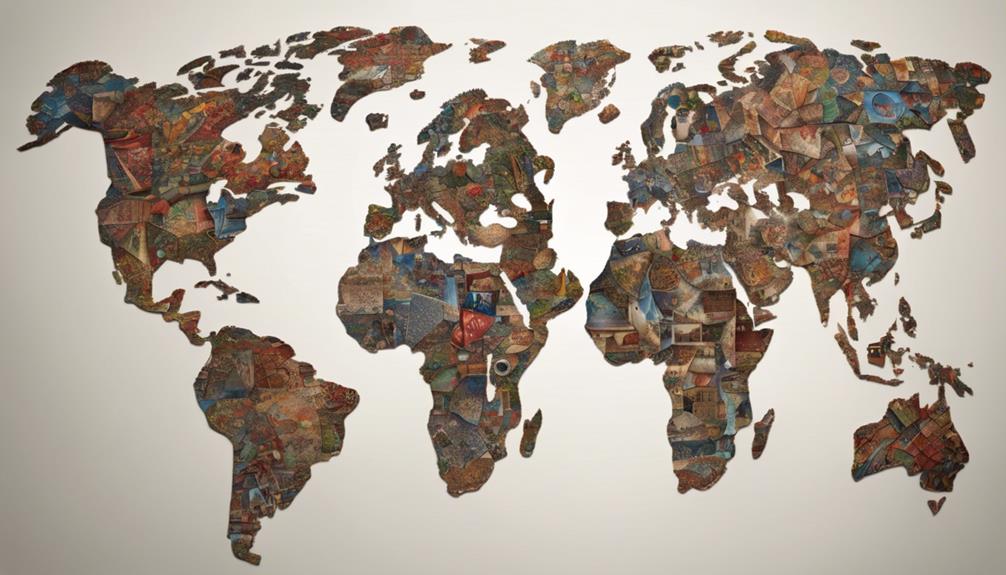
Cultural shifts are dramatically reshaping global politics, driven by digital nationalism, identity politics, and shifting values in the West. These shifts have sparked activist movements, challenged traditional governance structures, and raised critical questions about international relations. The rise of digital platforms has fueled nationalism, while identity politics has fragmented societies along racial, ethnic, and religious lines. As traditional authority erodes, new sources of influence emerge. Meanwhile, globalization threatens cultural diversity, and youth radicalization drives activism. As the global political landscape transforms, it's becoming clear that understanding these cultural shifts is key to maneuvering the future of international relations – and it's only just the beginning.
The Rise of Digital Nationalism
Through the democratization of online platforms, digital nationalism has emerged as a potent force, allowing individuals to mobilize and amplify nationalist sentiments across borders. This phenomenon has given rise to a new wave of cyber sovereignty, where nations are exerting control over their digital territories and imposing borders on the previously unregulated online space. The internet, once hailed as a borderless domain, is now being carved up into digital fiefdoms, with each country seeking to protect its online interests.
Digital nationalism has become a rallying cry for many, who see it as a means to reclaim their national identities in the face of globalization. Online platforms have enabled individuals to connect with like-minded individuals across the globe, creating a sense of community and shared purpose. However, this has also led to the proliferation of nationalist ideologies, which often perpetuate exclusionary and xenophobic rhetoric.
As digital nationalism continues to shape global politics, it raises important questions about the role of governments in regulating online spaces. Should they prioritize cyber sovereignty, or aim for a more open and interconnected internet? The answers to these questions will have far-reaching implications for the future of global politics and international relations. One thing is certain, however: digital nationalism is here to stay, and its impact will be felt for years to come.
Identity Politics Goes Global
As identity politics goes global, it's clear that nationalism is on the rise, driven in part by a cultural backlash against globalization. This shift is fragmenting societal identities, creating new fault lines and tensions within countries. As a result, policymakers must now navigate these complex, often competing, identity-based interests to shape effective global policies.
Nationalism on the Rise
Rising nationalist sentiments worldwide are redefining the global political landscape, fueling tensions between nations and sparking heated debates about identity, sovereignty, and cultural heritage. As nationalism gains momentum, governments are increasingly prioritizing border security, citing concerns over immigration, terrorism, and economic instability. This shift has led to a renewed focus on economic sovereignty, with nations seeking to protect their industries and jobs from perceived external threats. The emphasis on national interests has, in turn, led to a surge in protectionist policies, trade wars, and diplomatic tensions.
In this climate, traditional alliances are being reevaluated, and new ones forged. The resurgence of nationalist ideologies has also led to a rise in populist leaders, who often capitalize on public fears and anxieties to consolidate power. As nationalism continues to shape global politics, it remains to be seen how effectively nations can balance their pursuit of national interests with the need for international cooperation and diplomacy. One thing is clear, however: the world is entering a new era of identity politics, where national pride and sovereignty are taking center stage.
Globalization's Cultural Backlash
Globalization's relentless march has spawned a cultural backlash, fueling a sense of dislocation and discontent among communities feeling threatened by the erosion of their traditional ways of life. As cultural homogenization takes hold, many are pushing back against the perceived loss of national identity and cultural heritage. This backlash is manifesting in various ways, from the resurgence of nationalist sentiment to the revival of cultural practices and traditions.
| Cultural Expression | Globalization's Impact |
|---|---|
| Traditional Craftsmanship | Mass-produced, cheap imports |
| Local Cuisine | Homogenized fast food chains |
| Indigenous Languages | Dominance of global languages |
| Community Festivals | Commercialized, tourist-oriented events |
| National Identity | Eroding sense of shared values |
In response, many are calling for a cultural revival, seeking to reclaim and preserve their unique cultural identities. Border protection has become a rallying cry, as governments and citizens alike seek to safeguard their cultural heritage from the perceived threats of globalization. As the world becomes increasingly interconnected, the quest for cultural preservation and protection is becoming a defining feature of global politics.
Fragmenting Societal Identities
Cultural identities are splintering along fault lines of race, ethnicity, gender, and religion, giving rise to a kaleidoscope of identities that are redefining the political landscape. As individuals increasingly identify with specific groups, they're creating new fault lines that challenge traditional notions of community and nationhood. This fragmentation is fueled by the rise of identity politics, which has become a powerful force in shaping global politics.
The consequences of this trend are far-reaching:
- Community Fragmentation: As people identify more strongly with specific groups, they're less likely to engage with those who don't share their identity, leading to a breakdown in social cohesion.
- Identity Commodification: Identities are being packaged and sold as products, allowing individuals to curate personas that are driven by consumerism rather than genuine connection.
- Political Polarization: The fragmentation of identities is contributing to a growing political divide, as people become more entrenched in their beliefs and less willing to compromise.
As identities continue to splinter and evolve, it's essential to understand the implications of this trend on global politics. By recognizing the complexities of identity formation, we can work towards building more inclusive and cohesive societies that celebrate diversity while promoting unity.
Shifting Values in the West
Over the past few decades, Western societies have witnessed a profound transformation in their value systems, with traditional norms and institutions facing unprecedented challenges. This shift has led to a reevaluation of the Liberal Legacy, which has long been the cornerstone of Western democracy. The principles of individual freedom, equality, and tolerance are being questioned, and the notion of moral absolutism is giving way to Moral Ambiguity.
In this new landscape, the lines between right and wrong are increasingly blurred. The rise of relativism has led to a proliferation of conflicting values, making it difficult to discern a collective moral compass. This ambiguity has created an environment where individuals are forced to navigate complex ethical dilemmas, often without clear guidance.
The erosion of traditional authority has further contributed to this state of flux. Institutions that were once revered as pillars of society, such as the church and the media, have seen their influence wane. This has left a power vacuum, which has been filled by alternative sources of authority, such as social media influencers and online echo chambers.
As Western societies struggle to come to terms with these changes, they are forced to reexamine their values and priorities. This process of introspection is essential, as it will ultimately shape the course of their cultural and political evolution. By grappling with the complexities of Moral Ambiguity, Western nations can create a more nuanced and inclusive understanding of their Liberal Legacy, one that is better equipped to meet the challenges of the 21st century.
The New Era of Activism
Amidst the shifting values and Moral Ambiguity, a new wave of activism has emerged, driven by individuals who are no longer content to simply navigate the complexities of modern society, but instead seek to reshape its very fabric. This new era of activism is characterized by a sense of urgency and a willingness to challenge the status quo.
- Youth radicalization has played a significant role in this shift, as young people become increasingly disillusioned with the slow pace of change and take matters into their own hands. From climate strikes to social justice movements, youth-led activism has become a powerful force for change.
- Celebrity endorsements have also contributed to the rise of this new era of activism. As influential figures use their platforms to raise awareness about social and environmental issues, they inspire millions to take action.
- The proliferation of social media has further fueled this movement, allowing activists to mobilize and organize with unprecedented ease and speed.
As a result, we're seeing a new kind of activist emerge – one who is tech-savvy, socially conscious, and unafraid to challenge authority. This new era of activism is marked by a sense of optimism and a belief that real change is possible. As individuals and communities continue to mobilize and demand action, it's clear that this movement is here to stay – and that it will have a profound impact on global politics.
Globalization and Cultural Homogenization
As globalization spreads, it's feared that cultural homogenization will erase local identities, leading to a loss of diversity and uniqueness. The rapid spread of global brands and cultural norms has many worried that local customs and traditions will be lost in the process. This raises critical questions about whether the pursuit of uniformity is worth the cost of cultural diversity.
Cultural Erasure Fears
Six decades of accelerated globalization have fueled concerns that cultural homogenization is erasing unique cultural identities worldwide. As cultures blend and merge, the risk of cultural erasure grows, sparking fears that the diversity that once defined nations and communities will be lost forever. This phenomenon is often accompanied by cultural appropriation, where dominant cultures adopt and exploit the customs and traditions of marginalized groups, stripping them of their original meaning and context.
Moreover, historical revisionism plays a significant role in cultural erasure, as it distorts or omits the histories and experiences of certain groups. This can lead to a loss of cultural heritage and a distorted view of the past. The consequences of cultural erasure are far-reaching, threatening the very fabric of societies.
Some of the most pressing concerns include:
- Loss of traditional practices: As globalized cultures dominate, traditional practices and customs are abandoned or forgotten.
- Erosion of cultural diversity: The uniqueness of cultures is lost as they blend into a homogenous global culture.
- Invisibility of marginalized groups: The histories and experiences of marginalized groups are erased or distorted, leading to further marginalization.
Loss of Local Identity
Globalization's relentless march toward cultural homogenization has accelerated the loss of local identity, threatening to erase the unique characteristics that once defined communities. As multinational corporations expand their reach, they often bring with them standardized products and services that displace traditional practices and customs. This can lead to the erosion of cultural roots, as local businesses and artisans struggle to compete with global giants. The consequences are far-reaching, as communities begin to lose their autonomy and distinctiveness. Local festivals, languages, and traditions – once the fabric of community life – are slowly disappearing.
The loss of local identity has significant implications for community autonomy. When local decision-making power is ceded to external forces, communities become vulnerable to exploitation and manipulation. The homogenization of culture also leads to a loss of diversity, as unique perspectives and ways of life are supplanted by a generic, globalized culture. As the world becomes increasingly interconnected, it's essential to recognize the value of preserving local identity and cultural roots. By doing so, communities can maintain their autonomy and continue to thrive in the face of globalization's relentless march.
Uniformity Vs. Diversity
Multinational corporations, armed with standardized products and services, have become the drivers of cultural homogenization, paving the way for a uniform global culture that threatens to erase the diverse traditions and customs that once defined communities. As a result, the world is witnessing a clash between uniformity and diversity, with far-reaching implications for global politics.
On one hand, globalization has created a cultural mosaic, where different cultures coexist and blend together. This phenomenon has brought about unprecedented cultural exchange, innovation, and progress. On the other hand, the homogenization of cultures has led to the erosion of local identities and the loss of cultural diversity.
Here are three key consequences of this trend:
- Loss of cultural heritage: The spread of global brands and cultural norms is leading to the extinction of traditional practices and customs.
- Homogenization of values: The dominance of Western values and norms is threatening the diversity of moral and ethical standards across cultures.
- Erosion of community bonds: The rise of a uniform global culture is weakening community ties and social cohesion, leading to a breakdown of social structures.
As the world becomes increasingly interconnected, it's essential to strike a balance between uniformity and diversity, preserving the rich tapestry of human cultures and traditions.
The End of Traditional Diplomacy
As traditional diplomatic channels give way to modern forms of communication, world leaders are increasingly bypassing formal ambassadors to engage directly with one another. This shift is redefining the role of foreign bureaucrats, who once served as the primary conduits for international communication. Today, they're being sidestepped in favor of more direct, informal exchanges.
The consequences of this trend are far-reaching. Without the filters and protocols of traditional diplomacy, international relations can quickly devolve into diplomatic anarchy. World leaders, unencumbered by the niceties of diplomatic protocol, are free to speak their minds – and often do. The resulting exchanges can be fraught with tension, misunderstanding, and even conflict. This breakdown in decorum can erode trust between nations, making cooperation on global issues more challenging. In such a climate, international relations and the future of diplomatic engagement may become increasingly unpredictable, driven more by personal animosities than strategic interests. Ultimately, this shift could reshape alliances and geopolitical stability in unprecedented ways.
The erosion of traditional diplomacy also raises questions about accountability. Who is responsible when things go wrong? In the past, ambassadors and foreign ministries served as buffers, helping to diffuse tensions and prevent misunderstandings. Without these safety nets, the risks of miscommunication and escalation are heightened.
As the old rules of diplomacy give way to new, more informal approaches, the world is entering uncharted territory. The end of traditional diplomacy may bring benefits, such as increased efficiency and spontaneity. But it also poses significant risks, including the potential for diplomatic anarchy and unchecked conflict. As world leaders navigate this new landscape, they must find ways to balance the need for direct communication with the need for responsible, accountable diplomacy.
Social Media's Political Influence
Social media has dramatically altered the landscape of political discourse, as online platforms have become key arenas for political debate and discussion. However, this shift has also led to the creation of information echo chambers, where users are only exposed to views that align with their own. As a result, social media's political influence is a complex and multifaceted issue that warrants close examination.
Online Political Discourse
They tweet, they share, and they influence: online platforms have become a battleground for political ideas, amplifying voices and shaping public opinion like never before. The digital sphere has transformed the way people engage in political discourse, with social media platforms being the primary hub for online activism. However, this newfound freedom of expression has also led to a decline in cyber civility and online etiquette.
- The erosion of respectful dialogue: Online political discussions often devolve into personal attacks, hate speech, and misinformation, creating a toxic environment that stifles constructive debate.
- The amplification of extremist views: Social media algorithms can inadvertently promote radical ideologies, giving them an unwarranted platform and amplifying their influence.
- The manipulation of public opinion: Online campaigns can be orchestrated to sway public opinion, often using disinformation and emotional manipulation to achieve their goals.
As online political discourse continues to evolve, it's essential to establish a culture of cyber civility and online etiquette, where respectful dialogue and critical thinking are valued, and misinformation is actively countered.
Information Echo Chambers
In the era of curated content, people increasingly find themselves trapped in information echo chambers, where algorithms feed them a steady diet of ideologically aligned news and opinions. This phenomenon has significant implications for global politics, as it reinforces social segregation and hinders exposure to diverse viewpoints.
| Consequence | Description |
|---|---|
| Algorithmic bias | Social media algorithms prioritize content that confirms users' existing beliefs, perpetuating echo chambers |
| Social segregation | Online interactions often occur within homogeneous groups, reducing opportunities for cross-ideological dialogue |
| Polarization | In the absence of opposing views, individuals become more entrenched in their beliefs, leading to increased political polarization |
| Misinformation | Echo chambers can facilitate the spread of false or misleading information, further entrenching ideological divisions |
| Democratization of information | Social media platforms can amplify marginalized voices, but only if users actively seek out diverse perspectives |
As social media continues to shape online discourse, it's essential to recognize the risks associated with information echo chambers. By acknowledging these consequences, individuals can take steps to break free from algorithmic bias and foster more inclusive, nuanced political conversations.
Changing Notions of National Identity
As globalization and mass migration reshape the demographics of nations, traditional notions of national identity are increasingly being reexamined and redefined. This shift is driven by the growing diversity of populations, which challenges the idea of a single, monolithic national identity.
In response, new forms of national identity are emerging that blend different cultural influences. This phenomenon, known as Civic Hybridity, recognizes that individuals can possess multiple identities and allegiances simultaneously. For instance, a person may identify as both a citizen of their country and a member of a particular ethnic or religious group.
Three key trends are shaping these changing notions of national identity:
- Borderlands Dynamics: The intersection of different cultures and identities in border regions is giving rise to new forms of national identity that blend elements from multiple cultures.
- Civic Hybridity: As mentioned earlier, this concept recognizes that individuals can possess multiple identities and allegiances, leading to a more nuanced understanding of national identity.
- Transnational Ties: The increasing connectivity of the world's population is creating transnational ties that transcend national borders, further blurring the lines of traditional national identity.
These trends are forcing a reevaluation of what it means to be a citizen of a particular nation, and how national identity is constructed and expressed. As national identities continue to evolve, they will play an important role in shaping global politics and international relations.
The Growing Importance of Soft Power
Cultural shifts are dramatically altering the way nations project power and influence, with soft power emerging as an essential component of international relations. In today's global landscape, a nation's ability to attract and persuade others through its culture, values, and ideals is becoming increasingly important. This shift towards soft power is driven by the recognition that military might and economic coercion are no longer the only means of achieving global influence.
Cultural diplomacy, in particular, has become a key tool for nations seeking to extend their global influence. By promoting their cultural heritage, values, and ideals, nations can build relationships, foster trust, and shape international opinion. For instance, the United States has long been a leader in cultural diplomacy, using its music, movies, and education system to promote American values and interests worldwide.
The growing importance of soft power is also reflected in the increasing emphasis on cultural exchange programs, language training, and international education. These initiatives enable nations to build people-to-people connections, foster greater understanding, and promote mutual respect. As the global landscape continues to evolve, it's clear that soft power will play an increasingly important role in shaping international relations and global influence. Nations that fail to recognize the importance of soft power risk being left behind in the pursuit of global influence.
Cultural Exchange in the Digital Age
The rise of digital technologies has dramatically altered the landscape of cultural exchange, enabling nations to connect with global audiences and project their cultural influence in unprecedented ways. Today, cultural exchange is no longer limited by geographical boundaries, allowing people to engage with diverse cultures from the comfort of their own homes.
- Virtual Migration: The internet has enabled people to migrate virtually, allowing them to explore and experience different cultures without physically relocating. This has led to a significant increase in cross-cultural understanding and exchange, as people can now access and engage with cultural content from around the world.
Through digital platforms, individuals can form Cross Cultural Friendships, collaborate on projects, and share ideas, fostering greater cultural understanding and cooperation. Digital cultural exchange has also enabled the preservation and promotion of cultural heritage, as museums, libraries, and cultural institutions can now share their collections and exhibits with a global audience.
- Digital Cultural Content: The rise of digital content has enabled the creation and dissemination of cultural content, such as music, films, and literature, to a global audience. This has led to a significant increase in cultural diversity, as people are now exposed to a wide range of cultural expressions and perspectives.
- Cultural Diplomacy: Digital cultural exchange has also enabled governments to engage in cultural diplomacy, promoting their cultural heritage and values to a global audience. This has led to greater cultural understanding and cooperation between nations, as they can now engage in cultural exchange and collaboration on a global scale.
The Impact on International Relations
Five decades of accelerated digital transformation have rewritten the script of international relations, introducing a new era of global interconnectedness that is redefining traditional diplomatic channels. The rapid proliferation of digital technologies has enabled instant communication, facilitating unprecedented levels of global engagement. This shift has greatly impacted foreign policy, as governments must now navigate the complexities of virtual diplomacy and digital statecraft.
In this new landscape, global ethics play a critical role in shaping international relations. As nations increasingly rely on digital platforms to engage with one another, the need for a shared moral compass has become more pressing than ever. The digital domain has created new avenues for cooperation, but also presents novel challenges, such as cyber threats and disinformation campaigns. To address these issues, governments must develop a shared understanding of global ethics, one that prioritizes transparency, accountability, and respect for human rights.
The impact of cultural shifts on international relations is multifaceted. On one hand, digital technologies have enabled greater cultural exchange and understanding, facilitating people-to-people diplomacy and fostering greater global empathy. On the other hand, the digital domain has also created new avenues for cultural manipulation and propaganda. As international relations continue to evolve, it is essential that governments prioritize global ethics and work towards creating a more just and equitable digital landscape.
Rethinking Global Governance Structures
Global governance structures, once thought to be the cornerstone of international cooperation, are now facing unprecedented pressure to adapt and evolve in response to the rapidly changing global landscape. The rise of nationalism, the increasing importance of non-state actors, and the growing need for sustainable development have all contributed to the realization that traditional governance structures are no longer guaranteeing their purpose.
To address these challenges, many experts are calling for a rethink of global governance structures. This includes exploring new models such as Global Federalism, which would see the establishment of a more centralized and coordinated system of global governance.
Some potential solutions include:
- Institutional Reform: Strengthening and reforming existing international institutions to make them more effective and representative of the diverse range of stakeholders involved in global governance.
- Enhanced Multilateralism: Encouraging greater cooperation and collaboration between nations to address global challenges, while also recognizing the importance of national sovereignty.
- Increased Transparency and Accountability: Improving the transparency and accountability of global governance structures to make sure that they are more responsive to the needs of citizens and more effective in addressing global challenges.
Ultimately, rethinking global governance structures is essential if we are to address the complex and interconnected challenges facing the world today. By exploring new models and approaches, we can create a more just, equitable, and sustainable global order.
Frequently Asked Questions
How Do Cultural Shifts Affect the Global Economy and Trade Policies?
She argues that cultural shifts greatly influence the global economy and trade policies. As societies evolve, their values and preferences change, leading to increased economic nationalism. This, in turn, often results in the establishment of trade barriers, restricting international trade and investment. Consequently, businesses and governments must adapt to these changes to remain competitive, or risk being left behind in the rapidly shifting economic landscape.
Can Cultural Homogenization Be Reversed or Is It Irreversible?
She wonders if cultural homogenization is a one-way street. While it's true that globalization has led to a loss of unique cultural identities, she believes it's not an irreversible trend. A Cultural Renaissance, where local communities reclaim and celebrate their heritage, can be a powerful antidote. By supporting Local Revival initiatives, people can preserve traditional practices and promote diversity. It's a challenging task, but she's optimistic that with collective effort, cultural homogenization can be slowed, if not reversed.
Are Cultural Exchanges Still Possible in the Age of Nationalism?
She wonders if cultural exchanges can still thrive in an era of rising nationalism. As nations increasingly focus on preserving their national identity, cultural isolation becomes a growing concern. However, she believes that people's innate curiosity and desire for connection can overcome even the strongest nationalist sentiments. Through intentional efforts, cultural exchanges can still flourish, fostering greater understanding and tolerance in the face of cultural isolation.
Do Cultural Shifts Lead to More or Less Global Cooperation?
As the tides of cultural shifts ebb and flow, a pressing question arises: do these transformations lead to more or less global cooperation? She believes that when cultural shifts foster a sense of collective identity, they can strengthen global trust, paving the way for increased cooperation. However, if these shifts create divisions, global trust is eroded, and cooperation becomes a distant dream. It's a delicate balance, one that requires careful navigation to harness the power of cultural shifts for the greater good.
Can Soft Power Overcome the Challenges of Cultural Differences?
She believes that soft power can overcome cultural differences by leveraging cultural diplomacy to foster a shared global identity. By promoting cross-cultural understanding and exchange, nations can build trust and cooperation, transcending their differences. This approach enables countries to find common ground, paving the way for effective collaboration and mutual benefit. In essence, cultural diplomacy can help harness the power of diverse cultures to drive global cooperation and progress.
